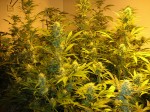
Photo: IliberadamariaWhile it might be all natural, it turns out that toking the green isn’t all that green. Especially if it’s grown indoors. A new study by Evan Mills, an energy analyst at the U.S. Department of Energy’s Lawrence Berkeley National Lab, examines the carbon footprint of the indoor marijuana industry. The results might kill your buzz if you’re an environmentalist:
The analysis performed in this study finds that indoor Cannabis production results in energy expenditures of $5 billion each year, with electricity use equivalent to that of 2 million average U.S. homes. This corresponds to 1% of national electricity consumption or 2% of that in households. The yearly greenhouse-gas pollution (carbon dioxide, CO2 ) from the electricity plus associated transportation fuels equals that of 3 million cars. Energy costs constitute a quarter of wholesale value.
California, the mecca of medical marijuana, is by far the worst offender. There, the indoor pot industry is responsible for about 3 percent of the entire state’s electricity use, or about 8 percent of all household use.
Some of the biggest growing facilities have a carbon footprint on par with many industrial medical and technology operations. According to Mills, a typical indoor marijuana growing facility has “lighting as intense as that found in an operating room (500-times more than needed for reading), 6-times the air-change rate of a bio-tech laboratory and 60-times that of a home, and the electric power intensity of a data center.”
Crunching the numbers, the report uncovers some other mind-blowing stats:
- A single joint represents 2 pounds of CO2 emissions, an amount equal to running a 100-watt light bulb for 17 hours.
- Each four-by-four-foot production module doubles the electricity use of an average U.S. home. The added electricity use is equivalent to running about 30 refrigerators.
- Processed marijuana results in 3000-times its weight in CO2 emissions.
- For off-grid production, it requires 70 gallons of diesel fuel to produce one indoor Cannabis plant, or 140 gallons with smaller, less-efficient gasoline generators.

So if you want to find those that are illegally growing marijuana, look at their energy bills.
Ah, but the electric companies are incentivized to not have anyone look too closely at the bills. Check out the documentary “the union- the business behind getting high.”
most if the illegal growing will be on hacked electricity
If only marijuana could grow outdoors and in the wild….
/sarcasm
All the more reason to legalize it so it can be grown outdoors
The fact that this was published in a reputable, peer-reviewed journal instead of on the author’s personal web site makes the conclusions much more credible.
Oh, wait a second…
It looks to me as if the paper was completed on April 5 – it may be that it hasn’t been out there long enough to make it’s way into a peer-reviewed journal, and he simply chose to publish it on his website in the mean time.
I see nothing wrong here.
Fair enough, Mark.
I’m not particularly doubtful of the general message (growing pot indoors uses a lot of energy), but his specific numbers seem shockingly high. I don’t have the disciplinary knowledge to recognize if his assumptions are valid, and there isn’t any sort of peer-reviewed process (yet). As such, this is a little bit too close to an “It’s on the Internet so it must be true” situation.
The guy has on his website a suitably lengthy list of publications in multiple publications with the range of topics varied and esoteric enough to not suggest a particular agenda beyond his stated field of study.
He links to another webpage at a lbl.gov domain and can be found listed in Lawrence Berkley Lab’s staff directory so it should be fairly safe to assume that he has the qualifications to make such claims.
In the FAQ to his article, the guy has gone to great pains to disclaim any conflicts of interest as well as dissuade readers from jumping to any unfound conclusions (both for and against legalization)that go beyond the scope of the paper e.g. he states that energy consumption can be reduced by as much as 75% without going outdoors so implying that the carbon footprint is due to marijuana’s legal status is largely invalid. This in itself proves nothing but is pretty atypical if this were just some random hack with a website trying to push his personal agenda.
Also if this guy really is some sensationalist publicity whoring scientist then design and layout of the website would have to be one of the most unimpressive attempts at internet marketing I’ve ever seen.
I’m all for greater scrutiny when it comes to the vast ocean of bad infromation that is the internet, but short of this being a very clever hoax it at least manages to pass the sniff test.
Peer-reviewed, reputable academic journals is the gold standard of establishing credibility but it shouldn’t be the only metric one uses to evaluate the truth.
So, if that’s the case, why don’t they let people grow their plants in their backyards and that’s it, end of the problem. No more dealers, violence, and excessive energy consumption! If you were trying to make smokers feel guilty you’ve failed badly, now we have one more argument in our favor. Leave us alone and grow our own plants y our own backyard!
I have never taken a single puff of marijuana, but this seems to be saying is that by driving marijuana growth “underground,” the U.S. government has not only created an unprecedented crime wave, spent billions on putting away minor “criminals,” but has also contributed to the destruction of our environment.
If the gov’t allowed it to be grown outside…problem solved. As well as putting a big dent in crime and the Mexican cartels (60% of their revenue comes from marijuana, per the gov’t).
I’ve had medical problem for approximately Ten years. I do not know whether I can qualify for medicinal ganja.
So not only would legalizing pot save millions of dollars in law enforcement and incarceration costs, reduce the crime that goes along with any profitable illegal activity, and generate lots of tax dollars, but it would help reduce global warming. I don’t really see a downside.