Photo: the Italian voiceA new report from the OECD paints a fascinating picture of how citizens from different countries stack up on an assortment of metrics: from who works the longest hours, who shops the most, to who is most trusting of others. The annual report, titled “Society at a Glance 2011 – OECD Social Indicators,” is chock-full with interesting data on all kinds of social behaviors.
Some of the interesting stuff in the report is about unpaid work and the value it adds to society. Some highlights:
- The value of unpaid work is very considerable: about one-third of GDP in OECD countries, ranging from a low of 19% in Korea to a high of 53% in Portugal.
- Most unpaid work is cooking and cleaning: on average, it’s 2 hours 8 minutes work per day across the OECD, followed by care for household members at 26 minutes per day.
- Americans spend the least daily time cooking per day (30 minutes) and Turks the most (74 minutes). At less than 80 minutes per day, the U.S. also has the third lowest time spent eating in the OECD. Interestingly, American obesity rates are the highest in the OECD: one third of our population is obese.
It turns out shopping counts as unpaid work, which gives the French a big boost:
- Top shoppers in the OECD in terms of daily time are France (32 minutes), Germany (31 minutes) and Canada (30 minutes), while Korea (13 minutes per day), Turkey (14 minutes) and Portugal (17 minutes per day) spend the least time shopping
Here’s a chart from the report on who does the most work per day, both paid and unpaid, measured in minutes:
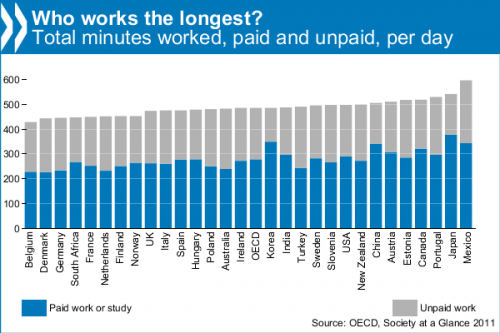

Portugal is high due to a quirk of an incentive: Lay offs are very costly due to regulations. But you can stop paying people. And if they stop showing up for work that’s cause for termination.
Obviously this last comment is not true. In Portugal you cannot stop paying people and it is almost impossible to fire people, even under-performers.
N1 – A portuguese who has worked in Portugal
i am the third
http://www.spacciohogan.com/
hmm, I wonder which Korea they’re talking about…
The Democratic Peoples Republic of Korea (North) is not an OECD country. The Republic of Korea (south) is, so this study should reflect their hours worked.
I wish Americans worked as hard as Mexicans, we’d all be rich. We should figure out a way to get some of them to come and live in our country. I don’t know what we could do to attract them here though.
East Asian Countries (Korea, Janap and China) have the maximum % of work time and the maximum time in absolute # of minutes spent on paid work.
I am wondering about the the causes for this:
1. Higher power distance and deference to authority in the culture of these countries (likely cause)
2. Simpler living (I found Korean cooking to be very quick and efficient, can’t speak for Japan or China – so possibile but not probable cause)
3. More tech savy living, more urbanization – Japan, Korea (possibile but not probable cause)
Having lived in Korea, I would say that a large portion would be due to urbanization and a tendency to “farm out” common chores. In the case of urbanization, lack of lawn care and easy access to very cheap restaurants makes it appealing to leave the (often quite small) apartments. That coupled with children who spend many more hours at school and clubs than in America (I knew many families who saw their kids on weekends only.) And finally add that you can get a really good maid for about 30 USD a week who will clean your whole house, organize and do the laundry/dishes. Being a lazy American, I never did any house work, and only cooked for pleasure.
I live in the coutryside of northern Japan.
1) People get a salary and are expected to work overtime for no extra benefits, just out of obligation. My boyfriend sells farm equipment and during harvest and planting seasons he is at work on national holidays and weekends. 7 days a week. No choice, no extra pay. Even drinking parties are pretty much mandatory.
2) Japan has strict cultural ideas of how to keep a house and how to be an “education-mama”. A household and family require a lot of care, children do no housework. The mother helps the children with their homework. Usually a woman is a full-time mom: cleaning, preparing elaborate boxed lunches, hanging laundry out to dry, ect. The father returns home late and usually does little housework in comparison.
This is generally and traditionally speaking, of course.
Japanalana, if the children do no housework, then how does each successive generation of women know *how* to do the housework and cook? Cooking, clothing care, and cleaning are not skill-free activities.
And how do they keep little kids from helping? The typical three year old *wants* to help with tasks that are important enough to occupy the attention of the adults. He or she might not stick with it for more than five minutes, but little children want to feel useful.
“Americans spend the least daily time cooking per day (30 minutes) and Turks the most (74 minutes). At less than 80 minutes per day, the U.S. also has the third lowest time spent eating in the OECD. Interestingly, American obesity rates are the highest in the OECD: one third of our population is obese.”
That’s an interesting point. Some cultures consider food to be of great importance: it seems plausible that these cultures would devote more time to preparing food that is high quality and healthy. Other cultures could emphasise convenience.
I moved from Ireland, where I saw food as an inconvenient necessity to keep me going, to Japan, where every city was famous for a particular food and my new colleagues constantly talked about it. I’m not surprised that countries like Ireland, UK and US have relatively high obesity rates. If food is just fuel then people may frequent takeaways, or eat frozen convenience food. If food is a beloved art we might expect better and healthier, if less convenient, options.