Can You Copyright a Tattoo?

Photo: emerille

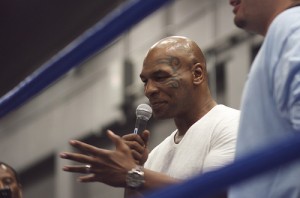
Former heavyweight champ Mike Tyson is famous for a lot of things, including biting off Evander Holyfield’s ear in a fight. A few years later he got this unusual tattoo on his face, also now famous.

Last week, Victor Whitmill, the tattoo artist who inked Tyson, filed suit against Warner Brothers, claiming they had infringed his copyright in Tyson’s tattoo. Which raises an interesting question: Can you copyright a tattoo? And if so, who owns it: the artist, or the person who has it on his skin? And what happens when it appears in a film?

The story begins with The Hangover: Part II set for release this Memorial Day weekend. In this follow up to the 2009 hit The Hangover, in which Tyson appeared, the characters reunite, travel to Thailand, have a few drinks too many, and another epic night unfolds. Actor Ed Helms wakes up the next morning with a facial tattoo that looks just like Tyson’s.

As the creator of Tyson’s tattoo, Whitmill believes that Warner Bros. has to pay him if it wants to reproduce his art on Ed Helms’ face.  And, perhaps surprisingly, he has a pretty good legal claim.  But there is a twist.

First, are tattoos subject to copyright? They are works of graphic art, so yes. Think of them just like an etching hanging on a wall. By applying the tattoo to Tyson’s face, Whitmill created a copyrightable work. Whitmill wants an injunction to stop the release of The Hangover: Part II because his art appeared in the film without his consent.

If the film had featured an etching by Whitmill, the studio would have had to get the rights to show it in the film “cleared”– that is, approved by the copyright owner. That clearance process is a major headache for a lot of filmmakers, especially documentarians who film real life—and therefore capture things like songs, TV shows, and art works. The same rule applies to the tattoo. So far, so good for Whitmill.

Second, does Warner Bros have a way out? The studio may claim that the tattoo is not original – it is clearly inspired by traditional Maori tattoos. But this is unlikely to work. Copyright’s originality threshold is very low, and even if Whitmill adapted his design from one in the public domain it will nonetheless be copyrightable if it is not copied exactly.

Warner Brothers may also claim that their use of the Whitmill tattoo is protected by the “fair use” doctrine. We haven’t seen the movie, so we can’t say for sure if this defense will succeed. But generally, unless the film uses the tattoo as parody (which it might) or uses it transformatively in some other way, it is unlikely to qualify as a fair use.  So the bottom line is that Whitmill’s claim is not frivolous, and he may well get a big payday from the studio just to make him go away.

Perhaps the most interesting issue is why he didn’t complain about the first Hangover movie, which also featured the tattoo, but on Tyson. If a studio has to get rights from the copyright owner to show a work of art in a film, it shouldn’t matter if the work is etched on a face or a piece of paper.

But here things get tricky.

Etchings on paper stay indoors. But Mike Tyson is going to walk around—and who is going to stop him? Because Whitmall’s tattoo is a work of art attached to a person, any judge is going to have a hard time holding that Tyson can’t do ordinary things because the tattoo artist owns the exclusive right to publicly display Tyson’s tattoo.

And for a celebrity like Tyson, ordinary things include appearing in films. So courts would tend to assume that there is an “implied license” between Tyson and Whitmill that Tyson will appear on camera now and again, and therefore so would the tattoo.

So the real problem here is not that the tattoo appeared in The Hangover: Part II—or, for that matter, in The Hangover—without Whitmall’s permission. It is that it was applied to Ed Helms. It is the copying that matters. So even if Helms’ scenes were left on the cutting room floor, but he kept the tattoo on for a few days while hanging out, Whitmill would still have a case. But Tyson can appear in as many films as he wants, and Whitmill is unlikely to get a dime.

Finally, there’s an overarching question here: given the risk that enforcing an artist’s copyright in a tattoo may interfere with the personal freedom of the person marked with the tattoo, should we have copyright for tattoos at all? To know the answer to this, we’d need to think about whether copyright has any real role in ensuring that tattoo artists have sufficient incentives to continue creating new designs. We may come back to this question in a future post.


Leave A Comment

Comments are moderated and generally will be posted if they are on-topic and not abusive.


COMMENTS: 22

  1. Rhema says:

    If you thought of tattoos as fashion items, then they cannot be copyrighted. No textiles can be copyrighted. Tattoos are something that you wear that can be removed. I see no legal basis here.

    Thumb up 0 Thumb down 1

    • Clifford D. Hyra says:

      There are no copyrights in clothing because clothing (in the U.S.) is considered a useful article. The design of the clothing is intrinsically tied up in the function of the garment. In contrast, fabric designs ARE entitled to copyright. Tattoos are clearly entitled to copyright protection.

      Thumb up 0 Thumb down 0

    • Mike says:

      Rhema – that’s not entirely true. You can get copyright in a “print” or pattern just not the design of the clothing itself.

      If you assume the copyrightability, most of the defenses raised in this article probably don’t apply (implied license) or are a real long shot (fair use).

      An implied license certainly exists for Mike Tyson’s appearance, but I don’ t know of any doctrine that would apply it to a third party, e.g., Ed Helms.

      Fair use also seems a long shot given the nature of the use. The only one of the four factors that seems to favor the movie is the “effect on market.”

      Thumb up 0 Thumb down 0

    • Matt says:

      Fashion is not copyrightable because it is primarily utilitarian, not because it can be removed. (Most paintings can be removed with turpentine, after all.)

      Fashion may only be protected by copyright to the extent that its shape is non-utilitarian enough to qualify as a creative “sculpture,” or to the extent that a design, pattern, or image on the clothing qualifies as “pictorial” or “graphic.”
      - Wikipedia

      Thumb up 0 Thumb down 0

    • Bird says:

      Tattoos can be removed

      Thumb up 0 Thumb down 0

  2. Kate Hutchinson says:

    Tattoo artist Elayne Angel has a very famous pair of wings tattooed on her back and those have been awarded a Service Mark. But that service mark is also tattooed next to the image.

    http://ringsofdesire.com/wingsregistration/index.htm

    Thumb up 0 Thumb down 0

  3. Matt says:

    What about hairstyles? Would the barber who tended to JFK’s locks have a claim against Devo for commissioning and sporting replica hairstyles on their album cover and in concert performances?

    Thumb up 2 Thumb down 0

    • James Curran says:

      Matt,
      _Precisely_ as I read you comment, Devo’s “Freedom of Choice” started to play on my MP3 player….

      Thumb up 0 Thumb down 0

      • Dvbackhamvn says:

        For the most part yes. However, and this is not a rule or law just a respect thing, if you have a totato artist spend the time and effort on drawing a piece for you, usually you should get that totato from that artist. It’s sort of like an unwritten law kinda thing. Unless you completely hate the design and work in which case I would wonder why you went to that artist in the first place. Anyways, the point is NO they should not charge you to draw it but if you get the totato they should do it.

        [WORDPRESS HASHCASH] The poster sent us ’0 which is not a hashcash value.

        Thumb up 0 Thumb down 0

  4. Lydia says:

    This is not the first time a tattoo artist has sued for the use of a celebrities’ tattoo in a way that goes beyond what would be considered within the bounds of that “implied license”.
    Christopher Harkins article in the Lewis and Clark Law review addressed the use by Nike of Rasheed Wallace’s tattoo: TATTOOS AND COPYRIGHT INFRINGEMENT: CELEBRITIES, MARKETERS, AND BUSINESSES BEWARE OF THE INK, Vol. 10 issue 2 Lewis and Clark Law Review (2006). Available:
    http://legacy.lclark.edu/org/lclr/objects/LCB10_2_Harkins.pdf

    Thumb up 0 Thumb down 0

  5. Robert says:

    The unasked, and important, question here: does the tattoo fall under “work for hire”. Artists performing work for hire do not own the copyright, the person who commissions the work does. If Mr. Tyson contributed to the design process (which I suspect), he would be a co-creator. If he co-created the tattoo and commissioned it as a “work for hire”, the artist has no standing.

    Well-loved. Like or Dislike: Thumb up 7 Thumb down 0

  6. John says:

    The way I see it, the copyright for Tyson’s tattoo isn’t just a mere matter of an implied license between tattooer and tattooee. It is a joint work of art in which both share copyright protection. After all, it’s Tyson who commissioned the artwork and who brandishes it on an essentially permanent basis.

    As such, it would be interesting to see whether WB could get away with obtaining only Tyson’s release for use of the tattoo.

    It would also be interesting to see whether they could claim that once the artwork is copied onto another person, that in itself constitutes fair use, as the tattooee himself could be construed as an intrinsic element of the artwork in question.

    Thumb up 0 Thumb down 0

  7. Firebird says:

    Unless this tattoo was out of the artist’s design portfolio wouldn’t it count as a commission and the copyright more reasonably belong to the owner of the piece, ie. Mr Tyson? If I paid an artist to do a one off tattoo I’d be more than a little bit angry if he then decided he owned it and started putting it on other people. In the case of such a prominent piece on a celeb I’d expect him to have insisted that it NOT be done on anyone else as part of the contract, effectively denying the artist the right to copy it. No copyright.

    Thumb up 0 Thumb down 0

  8. kurt says:

    What about the issue that tyson paid whitmill for the original art? Wouldn’t this be like commissioning an artist? Don’t the payer own the copyright on the art?

    Thumb up 0 Thumb down 1

    • Todd says:

      As every young bride knows, the payer does not own the copyright. That is why, when hiring a wedding photographer, it is important to determine at the point of hire who will own the photos. If you don’t own them, you need to pay the photographer to make copies.

      Thumb up 3 Thumb down 0