
Are Bad Storms Good Long-Term News for Insurance Companies?
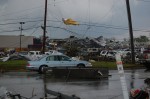
According to the National Weather Service’s Storm Prediction Center in Norman, Okla., there have been 1,151 tornadoes reported (though not confirmed) so far this year. By comparison, there were 1,282 tornadoes during all of last year, and a total of 1,156 in 2009. This is resulting in billions of dollars in damage claims across much of the South and Midwest. According to EQECAT, which provides disaster and risk models to insurance firms, weather-related losses could cost insurers upwards of $10 billion in the U.S. this year, up from an average of between $2 and $4 billion per year.

But while the short-term impact will obviously be difficult as insurance companies cover record losses, the recent rise in weather-related disasters could end up being good for their stock prices. As CNBC’s Mary Thompson points out, insurance stocks sometimes experience nice rallies following periods of natural disasters as they’re able to pass costs onto customers through higher premiums.

Sandler O’Neill analyst Paul Newsome thinks the increase in storm frequency and severity will force insurers to change their catastrophic loss models for determining premiums to charge. Typically catastrophe losses are modeled as 3 percent to 4 percent of premiums collected; he sees this rising to 5 percent to 6 percent.

There’s already evidence of premiums going up in some hard-hit states. From the Insurance Journal:

More than 400 Oklahoma schools have received notices of expected insurance rate increases averaging 19.5 percent.

The notice from the Oklahoma Schools Insurance Group, which provides various types of coverage to 440 of Oklahoma’s 526 school districts, comes after schools were told that state funding for public education will be cut by 4.1 percent in the next fiscal year.

Leave A Comment

Comments are moderated and generally will be posted if they are on-topic and not abusive.


COMMENTS: 17

  1. Joe says:

    Any blackjack player will tell you that insurance is a sucker’s bet (unless you’re counting and the count is *very* high). Do you think Warren Buffett has health insurance?

    Thumb up 0 Thumb down 4

    • Rucksack Revolution says:

      Any blackjack player will also be able to tell you how important it is to minimize risk of ruin. For a person who cannot afford a particular monetary loss (be it a medical bill, natural catastrophe, or loss of family provider) insurance can be a great way to reduce variance and risk of ruin. However, if you can afford a given monetary loss you are usually better off paying out of pocket, though there are many exceptions to this.

      Thumb up 0 Thumb down 0

  2. Aaron says:

    Yes Buffet has insurance. He is on medicare just like every American over 65. At his income/asset level, though, he probably chooses to pay out of pocket above that coverage.

    Thumb up 3 Thumb down 0

    • James says:

      I know very little about Medicare, but my impression was that one had to enroll in order to be covered. If not, and coverage is automatic , then if Warren Buffet is in fact on Medicare it’s not by his choice, any more than it’s my choice to be covered by unemployment insurance.

      Thumb up 2 Thumb down 0

  3. caleb b says:

    Insurance is the best business model because if times get tough, all an insurance company needs to do is stop paying claims.

    Banks and insurance companies are very similar. One bets that you will be able to repay a loan, the other bets that you won’t have a claim. They make money by receiving more (in loan interest & premiums) than they pay out (in deposit interest and paying claims). They invest any extra funds (mostly in the same type of assets.).

    Here is where banks and insurance companies really differ. A bank cannot control when you stop paying your loan, but an insurance company can decide, arbitrarily, not to pay a claim. Sure, you can sue the insurance company. But according to the law, you can only recover what they were supposed to pay in the first place (plus legal expenses). There are no punitive damages for insurance companies for failing to pay claims.

    From 2008 to today, 365 banks have been closed by the FDIC. By the time this cycle is over, the number will probably be over 500 or 600 banks. How many insurance companies have failed in that same time? Less than 10. You tell me, which would you rather own, a bank or insurance company? Buffet prefers insurance.

    Thumb up 3 Thumb down 2

    • John B says:

      “There are no punitive damages for insurance companies for failing to pay claims.”

      Not true. Companies get sued every day for bad faith claims.

      What they do to save money is to slow down the process, offer lower sums etc. But most try to avoid bad faith claims.

      Thumb up 3 Thumb down 0

      • Caleb b says:

        ERISA covers most life and health insurance companies from punitive damages.

        Thumb up 1 Thumb down 0

  4. YX says:

    It’s like car insurance. I will need to total my car or cause similar damage within 5 years to “break even” – if you call losing 10-20k for no good reason even (and I have a clean record). And if I somehow manage to do it, insurance will just jack up price and I’m forced to buy it by law. Practically, the only way for insurance company to not make money off you is run over someone and then go to jail. It should not be called insurance, it should be called robbery.

    Thumb up 1 Thumb down 3

    • pawnman says:

      The insurance you’re required to have by law covers other people for your carelessness, not your own car. You’re perfectly legal to carry no insurance on your own car whatsoever, the law only requires “liability insurance”, which means your insurance company will pay to fix the other person’s car and pay their medical bills if you are at fault in the accident.

      Thumb up 3 Thumb down 1

    • uthor says:

      If you’re paying 10-20k every five years with a clean driving record, you’re doing it wrong. It’d take me 20-25 years of paying insurance to equal what my car cost new, and that’s not including potential costs to other vehicles or enormous medical bills that could result (full coverage with a moderate premium). I need to total my car along with the other driver’s once in my life to cover what I pay in insurance. I need to put one of us in the hospital to cover what I’d pay in insurance over several life times.

      Thumb up 2 Thumb down 1

      • YX says:

        5 year driving history, both me and my wife under 25, new car on payment (so have to get full coverage). Go ahead, see how much that quotes… (2700).

        Thumb up 0 Thumb down 0

      • YX says:

        Seriously, how many person you know that totaled his/her own car along with other driver’s? 1 out 100, if that? How many person you know who put someone in hospital? So you would pay the full price of a 1 in 100 event in hope to avoid a 1 in 1000 event, really?

        Thumb up 0 Thumb down 0

  5. Jett says:

    It’s easy to see here who works with insurance and who doesn’t.

    Most people fail to realize that insurance is purely a mechanism of risk transfer. You’re paying for the ability to sleep at night. You would hope to never ‘break even.”

    Thumb up 0 Thumb down 0

    • YX says:

      I personally sleep better with more money in the bank. Insurance companies take money from everyone, pocket a portion of the money (unless everyone who works for insurance companies are volunteers, quite a big chunk), give the money to the worst of the group (even if the payment goes to the victim, it still benefits those who causes the accidents, since they need to pay the victim anyway), and then call their buddies at government to make it mandatory. Now tell me again, why is this a good deal?

      Thumb up 0 Thumb down 0

    • YX says:

      I personally sleep better with more money in the bank. Insurance companies take money from everyone, pocket a portion of the money (unless everyone who works for insurance companies are volunteers, quite a big chunk), give the money to the worst of the group (even if the payment goes to the victim, it still benefits those who causes the accidents, since they need to pay the victim anyway), and then call their buddies at government to make it mandatory. Now tell me again, why is this a good deal?

      I don’t mind it IF it is a choice. I am a safe and alert driver, so I would like to take my chances. If I do cause an accident, I would take my lick and pay it with my own cash.

      Thumb up 0 Thumb down 0

      • Will says:

        So you are fine “taking your lick” if you cause a serious accident and paralyze someone causing millions of dollars in medical expenses that you are legally responsible for? I’m sure Warren Buffet would be fine accepting this risk, but the average citizen does not have millions of dollars sitting in the bank in case they seriously injure someone.

        What if your house burns down? Do you have hundreds of thousands of dollars sitting around to just replace it? Maybe you do, but again, the average citizen does not and should be fine paying a relatively small amount in insurance premium compared to the potential losses they could suffer. It’s simply a transfer of risk, not a very complex idea to grasp here.

        I’m sorry my friend, but you are completely out to lunch on the concept of insurance.

        Thumb up 0 Thumb down 0

      • Syed says:

        I don’t believe that YX has hundreds of thousands of dollars in the bank. If he did, he wouldn’t have bought a car on payments.

        Thumb up 1 Thumb down 0