
Taking Lab Rats Seriously: The Case Against (Most) Animal Testing
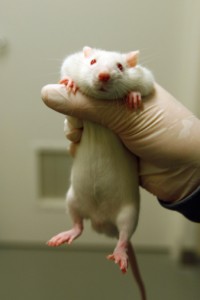
(Hemera)

Billions upon billions of animals are used every year for the purposes of scientific experimentation. It’s actually hard to think of another practice that’s as commonplace as it is controversial (biotechnology, perhaps?). It goes without saying that many of these experiments are a waste of time and resources. The NIH, for example, recently spent about $4 million exploring how the menstrual cycles of monkeys were influenced by cocaine, meth, and heroin. Other animal-based experiments, however, appear to have genuine utilitarian value, contributing useful information to our knowledge of Parkinson’s, Alzheimer’s, and several cancers. Delve into this issue and you’ll find that only one thing is certain: clear answers aren’t forthcoming.

I generally believe that animal experimentation is a morally flawed way to accumulate scientific knowledge. That said, I plead agnosticism when it comes to rare cases of direct benefit to human life. I’m sure that if one of my children were afflicted with a life threatening disease and experimentation on monkeys had a plausible chance of finding a cure, I’d reluctantly support that research. As much as I’d like to be consistent on this issue–as I’m able to be with, say, my diet–I’m afraid I must take convenient refuge in Emerson’s saying about foolish consistency and little minds. As I said, nothing about the morality of animal experimentation is easy.

Perhaps one way to come to terms with this conundrum is to consider animal experimentation in more abstract terms, rather than on a case-by-case basis (with many of those “cases” being purely hypothetical).  As I see it, one point in particular transcends specific examples of animal experimentation to suggest that we should be doing everything possible to eliminate the practice altogether–except perhaps in the most extreme cases of direct human benefit.

The point has to do with the fact that, as scientists use animals to further scientific knowledge, they do so without a full, or even half-full, understanding of the animals they’re exploiting. Animal experimentation has been happening for hundreds of years, but the field of animal ethology–the study of animal behavior and mentality–is relatively new.  Because the cart of experimentation has been put before the horse of knowledge, scientists routinely end up not only inadvertently harming animals, but unknowingly executing flawed experiments bound to yield inconsistent, and thus ultimately useless, results.

Animals, unlike objects, have emotions. Mice, rats, birds, or apes kept under one set of conditions will react differently to the same experimental stimuli than will mice, rats, birds, or apes kept under another set of conditions. Only now, however, are we coming to realize how incredibly sensitive experimental animals are to differential experimental environments, handlers, and procedures. The implications of this sensitivity have radical implications for every experiment done on an animal.

A couple of real life examples, both taken from Bernard Rollin’s insightful book Animal Rights and Human Morality, highlight the problem. The first involves mice and the experience of shock. In order to gain insight into the human experience of shock, scientists have long traumatized mice and studied their “microcirculatory shock profile.” Put aside for now the question of the experiment’s utility, and consider something even more problematic: scientists simply assumed that all mice yet to be traumatized by the scientists were starting from the same emotional/physiological baseline. In essence, that they were all passive objects awaiting human action within the framework of an experiment designed to induce trauma.

In point of fact, as Rollin himself, a philosopher no less, had to remind members of the Shock Society (yes, there’s a Shock Society), the mere act of picking up a mouse and shifting it a few feet into position initiates a shock response. Scientists who might have been rearranging animal subjects for clinical traumatization would have been unwittingly already traumatizing their subjects, thereby screwing up the results and rendering the entire experiment, not to mention the harsh treatment of the rodents, totally pointless.

Hence we come to what may very well be the inherent problem of animal experimentation: because we can never predict how an inarticulate animal capable of experiencing fear or pain or distress will react to the almost incalculable and endlessly subtle stimuli of any scientific environment, we can never fully trust the experimental results.

As this next example illustrates, the assumption of animal objectivity, and the concomitant failure to consider the extraordinary emotional responsiveness of animals, can be hideously callous. Scientists have long wanted to understand the nature of deer mule starvation. Again, let’s ignore the utility question and get to the execution of the experiment (and, I guess, the mule deer).

In an infamous experiment, the researcher simply placed a mule deer in a cage and withheld food, taking chemical readings of its rumen until it died.  Remarkably, the scientist’s control group–mule deer that were fed–were housed in a cage adjacent to the starving deer, affording the tormented creature olfactory and visual exposure to the food it was being denied. Putting aside the obvious stupidity of the experiment, the stomach secretions emitted by the starving deer were completely driven by the control group, thus rendering the results useless. And all because the researcher failed to understand a basic principle of animal ethology.

The rationale for all animal experimentation is, if you think about it abstractly, troublesome. Scientists use animals because they’re physically similar enough to humans for results to have possible meaning. At the same time, they use animals because they are–so we have long thought–cognitively and emotionally different enough from humans for our exploitation of them to be morally justified. But the more we learn about animals, the more we are realizing, as Darwin himself explained (in Rollin’s summary): “thought and feeling in animals [is] an inevitable consequence of phylogenic continuity. If morphological and physiological traits are evolutionarily continuous, so, too, are psychological ones.”

This sobering scientific reality, at the least, demands that we take a much closer look at how and why–and to what effect– we use animals to serve the interests of science. My sense is that, the closer we look at non-human animals, and the more we learn about them, the harder it will be to understand their behavior and, in turn, justify our own.


Leave A Comment

Comments are moderated and generally will be posted if they are on-topic and not abusive.


COMMENTS: 55

  1. Whitney says:

    I completely agree that animal testing should be further explored/understood and limited to real human need. The key thing to remember, however, is that animal testing is federally mandated as part of the process of drug development – so much of it would go unchecked without further regulation/change of requirements. Without a legitimate model that works in place of animals for initial drug testing, I doubt that would ever fly. So, the effort should not be put toward making a moral argument, but put towards research towards an alternative.

    Well-loved. Like or Dislike: Thumb up 19 Thumb down 4

    • Enter your name says:

      FDA-mandated animal testing is about safety, not efficacy or basic knowledge, which he doesn’t even address. The ideal result is that, after you fed half the subjects a large amount of your test substance, all of them lived happily ever after.

      Every single drug the FDA has approved has been tested in at least two species (usually one rodent and one non-rodent). The basic question we’re asking in these studies is whether the substances are unexpectedly poisonous. The reason we ask this question in this way is because any fool can write a computer program that says “Of course this molecule that we’ve spent 300 million dollars on is perfectly safe. Go right ahead.” Personally, I appreciate knowing this before we put these potential poisons into even one human.

      In practice, if you don’t want to support animal testing, you either need to stop taking drugs or volunteer to be a first-in-animal test subject.

      Well-loved. Like or Dislike: Thumb up 56 Thumb down 10

  2. Cameron says:

    It seems that you suggested that “Perhaps one way to come to terms with this conundrum is to consider animal experimentation in more abstract terms, rather than on a case-by-case basis (with many of those “cases” being purely hypothetical),” but haven’t you, in fact, done completely the opposite in this piece?

    Does presenting to cherry-picked examples of arguably questionable animal research really help further this debate in a constructive way?

    Well-loved. Like or Dislike: Thumb up 54 Thumb down 7

  3. Trevor says:

    1) Many (most?) experiments on animals do not have a dependency on their emotional state. Think, for example, drugs for things like cancer – these rely on biological / physiological processes that are fixed
    2) If the sample set is not as uniform as we thought, then control for it / select better
    3) As you concede in the case of the mule deer, simply design the experiments better (in the UK, you can’t keep animals to be tested / as a control in the vicinity of other subjects anyway)

    None of your arguments is directly against animal testing; rather you say “it’s hard, and there are problems we have not fully thought through”. The conclusion that we should therefore cease is a non sequitor

    Well-loved. Like or Dislike: Thumb up 41 Thumb down 8

  4. Carnett says:

    I suggest you go into your local university and take a look around to see exactly what type of animal testing occurs and how essential it is for day-to-day science, and the ethical constraints that modern day scientists have to go through. Most of the points in your article highlight your extreme ignorance in biology, and the scientific method in general. I suspect your opinions on animal testing are based on a few fringe experiments conducted either before ethical guidelines and rules were established, or outside them somehow. Finally your last sentence is paradoxical; it physically cannot be harder to understand something once we learn more about it. Please stick to economics in an economics blog.

    Well-loved. Like or Dislike: Thumb up 50 Thumb down 8

    • Uthor says:

      “Finally your last sentence is paradoxical; it physically cannot be harder to understand something once we learn more about it. ”

      While technically true, that’s not what the author meant. Initially, one’s understanding (in this case, about animals) is driven by assumptions. Where we once understood animals (and other phenomenon) based on simple principles, we learned more about them and found them to be more nuanced than previously thought.

      Look at physics. We understood physics pretty well using Newtonian principles until we learned enough to know that they don’t always apply. We needed to come up with quantum mechanics, which is harder to understand compared to Newtonian physics, and we used quantum mechanics to find further limits of our knowledge and need to come up with even more refined (and hard to understand) principles like string theory.

      Thumb up 6 Thumb down 3

    • hibob says:

      I absolutely agree that a better understanding of how animal research is actually done would have precluded the bulk of this article. But one thing the author really couldn’t do very easily is “go into your local university and take a look around” at animal research. Along with the ethical constraints that laboratories follow these days, variations like who has access to the vivarium is strictly controlled. turning on the lights at a different time than usual, new people in the room – pretty much anything can affect an experiment. And then there are security concerns. At my old institute, knowledge of how to even find the building where primates were kept, let alone access to the facility itself, was strictly need to know.

      Thumb up 0 Thumb down 1

  5. Brandon says:

    This article demonstrates a fairly common misunderstanding held by those outside the scientific community in regard to the utility of animal experimentation and the treatment of those animals. Sure, animals are occasionally mistreated and sometimes the experiments are difficult to stomach. All the same, knee-jerk reactions and arm-chair speculation by someone without direct experience with such trials is dubious at best. To out-of-hand dismiss any knowledge gained from such experiments as useless without being well acquainted with the goals and outcomes is downright foolish. Most of the scientists I know who work with animals in their experiments treat them with a great deal of respect and gratitude (even verbally thanking each and every mouse). Though unfortunate, there are often (very often) no better ways to test complex physiological hypotheses than on a complex live subject. And regardless of whether the knowledge gained has direct, human implications, it is valuable nonetheless. There are no failures in science, only learning experiences.

    Well-loved. Like or Dislike: Thumb up 51 Thumb down 13

    • Rebecca says:

      I’m not sure you read the article. I find nothing knee-jerk or dismissive about the author’s point of view. While MOST of the scientists you know respect their test subjects, you’ve acknowledged that SOME of them don’t, not to mention those scientists you don’t know (a base point I’m making, but true.) The purpose of this article is to acknowledge that, while some animal testing is necessary (if not a necessary evil), many experiments are not monitored properly, are unethical or unnecessary.

      Hot debate. What do you think? Thumb up 12 Thumb down 17

  6. Dan says:

    This post has no business appearing on this blog. Can you tell me what this has to do with economics, or even freakonomics?

    Well-loved. Like or Dislike: Thumb up 36 Thumb down 14

  7. Jaime says:

    As someone with considerably lower empathy levels for non human animals than humans I am probably bias in my comments but there are many counter-conclusions I believe can also be reached at following the same train of thought as James here posed.

    For starters I would argue that no scientific experiment is ever done fully knowing, even half knowing all of the possible parameters (the lack of a unified theory to explain even the most basic concepts pretty much sums this up) and asking that scientists aim to know more before they experiment as a means to validate their results is a fallacy. We work in best guesses and hypothesis and few good scientists make claims in absolute terms ever, even when their results lead to things that work.

    However, repeated experience has shown that our best guess and hypothesis method works. We have conquered air and water, day and night, even space with such guesses. Most of this at the expense of some animals I might add.

    As a second point I would like to bring up the fact that as was pointed out, humans and animals do not share enough of a biological base to make good test subjects. Likewise, however, does this introduce a counter-argument: Humans and non-human animals differ at such a basic level that if we assume that experiments on them are inherently flawed from our inability to understand both our own and their emotional/physiological responses then it would be yet an other fallacy to assume that the same things that traumatize/scare/harm us mentally or emotionaly would have the same effect on non human animals, as a matter of fact it would be equally wrong to even state that despite achknowleding that difference we can somehow understand non-human animal emotional/physiological responses. For all we know all mule deers are masochists and somehow enjoy starvation.

    I hope that last comment brought attention to what should be the conclusion to take away here, that assuming too much, whether it is about what non-human animals may or may not feel will lead us deeper into ignorance. And furthering ignorance is probably the most counter-evolutionary trait we have.

    Personally I believe we should strive for more understanding but never at the expense of other, just as valuable knowledge. Truly understanding a non human animal’s emotional/physiological aptitudes should be seen with as much scientific rigor as is put in understanding the diseases/conditions/treatments/etc we try to understand by experimenting on animals. But assuming too much to take a stance on any controversial issue just polarizes the arguments and makes us forget our ignorance, and IMO, that is worse.

    Hot debate. What do you think? Thumb up 13 Thumb down 11

  8. jamie says:

    I’ve always thought of testing on animals as something of a moral imperative: It’s that or release untested drugs on the world, surely?

    The argument here doesn’t seem to be don’t test, but test effectively. I’m sure everyone agrees with that, and I think the standards are pretty rigorous – that’s not to say they shouldn’t be subject to checks and improvements.

    Slightly disappointed in Freakanomics for posting this blog, I agree with Carnet, stick to economics!

    Well-loved. Like or Dislike: Thumb up 19 Thumb down 10