
Can You Trademark a Color?

Could Pablo Picasso sue Claude Monet for using his signature melancholy blue color? That question was raised this week by a federal judge in New York. The suit before the judge was not actually brought by Picasso. But it did involve a trademark in a color.
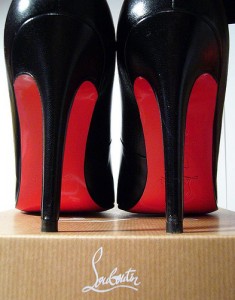
As his many fans know, Christian Louboutin is an artist of the foot. His shoes are widely revered (see songstress Jennifer Lopez’s ode, “Louboutins”) and not cheap: close to four figures in many cases, and sometimes more. Louboutin shoes also feature a well-known quirk: red soles. And when the venerable fashion house of Yves St. Laurent began selling red soled shoes recently, Louboutin—who had trademarked said soles in 2008—quickly sued.

The judge in this case did not doubt that Louboutin’s red soles fulfilled the fundamental purpose of trademark, which is to designate the source of a good. And colors have been successfully used as trademarks before—Owens Corning’s pink color for fiberglass insulation, for example, is trademarked.

But the general understanding in American law is that colors can only be trademarked if they serve—and only serve– to identify the source of a product. They cannot serve any other function. The interesting question here was whether enhancing beauty is an “other function,” such that red soles cannot be trademarked lest this unfairly inhibits competition. In other words, can aesthetics be functional?

To think this through, the judge analogized to a hypothetical dispute between Monet and Picasso over a particular shade of blue. As in fashion, he wrote, in painting, color is “an indispensable medium” of expression. To give control over a color to a single artist would both hinder art and harm competition. Likewise, reasoned the judge, a color cannot be monopolized by a single fashion designer.

Louboutin’s own declarations in the case, moreover, gave ammunition to the view that aesthetics can be functional. Louboutin declared that he chose red because it gave the soles “energy,” and was “sexy” and “engaging.” These seemed to the judge like functional attributes that made the product more competitive. As a result, like an earlier case in which black was held to be functional for marine outboard engines (it is slimming, after all, and goes well with anything), red was declared to be a functional color for shoes. Score 1 for Yves St. Laurent.

The YSL-Louboutin dispute has implications for other aesthetic issues. Many consumers like to show off what they buy. And Louboutin’s signature red soles scream, “I paid a lot of money for these beautiful shoes!” There are certainly other ways for designers to enable the signaling of conspicuous consumption: special ties or straps, shapes, and so forth. But a signature sole color was a great marketing idea, and clearly penetrated the consciousness of the high-end shoe buying public (and lots of aspirational shoppers too).

So while the judge’s reasoning in this case makes some sense—perpetual control over a color for shoe soles is not going to foster a competitive marketplace—it tends to encourage greater use of garish and visible trademarks. And that’s an aesthetic issue of another stripe.

Leave A Comment

Comments are moderated and generally will be posted if they are on-topic and not abusive.


COMMENTS: 25

  1. Eric M. Jones. says:

    In my youth, I read a scifi novel where a kid discovered a crashed flying saucer. All I can remember of the novel was the notion that he entered the spaceship and saw a PRIMARY color that no Earthling had even seen. This fascinated me and I pondered the possibility endlessly.

    Of course, it is impossible. But in truth you see billions of spectrum colors. So is the lawsuit about ANY color used on soles, or a particular, narrowly defined color? Either would seem an impossible lawsuit.

    BTW…That’s a SMOKIN’ photo.

    Well-loved. Like or Dislike: Thumb up 7 Thumb down 0

    • Gary L. says:

      I have long pondered whether the colors we see in our mind’s eye are the same. I see the “Thumb Up” button, and I see that its green, but I only know that this is green because I’ve been told this is green, and learned to associate this color with the color green. What if my mind has everything off by 1/3 rotation from what everyone else sees on the color wheel? Maybe what I see, and know to be green, looks like purple to everyone else. Since we describe a color in the context of other colors, as long as my perception was merely shifted along the color wheel, we’d never know that the color we see is different.

      Perhaps a difference in the way color data is interpreted by our eyes and our minds explain differences in color preferences.

      Even putting it into words is difficult. Actually pondering it makes my slightly paranoid and gives me a headache.

      Well-loved. Like or Dislike: Thumb up 16 Thumb down 6

      • Wrenkin says:

        Cf. “Mary the Colour Scientist”: http://en.wikipedia.org/wiki/Mary%27s_room .

        Well-loved. Like or Dislike: Thumb up 6 Thumb down 0

      • Gary L. says:

        Awesome read. Thanks!

        Thumb up 1 Thumb down 0

      • Ulysses says:

        This is something everyone probably thinks about at some point. But IMO, clothing and decor and design answer this, that the non-color blind do all experience the same colors (before even getting into the physiology of rods and cones as well as EMR). The fact that most of us agree on what colors look good with what is a telling indicator.

        Thumb up 3 Thumb down 1

      • Joseph McGinley says:

        That is very interesting as I have often thought of the exact same concept, it is very hard to put into words I agree as I have tried to explain this on numerous occasions, although yours in quite succinct!

        Thumb up 1 Thumb down 0

    • Jeffrey W. says:

      It’s not impossible to have 4 primary colors: birds have 4 primary color including one in the ultraviolet range. They see a range of colors that is impossible to imagine.

      Thumb up 2 Thumb down 0

  2. Amy says:

    Awesome article! So great!

    Thumb up 1 Thumb down 1

  3. AaronS says:

    I don’t think the issue here is color. It is the specific, proprietary use of that color. Namely, for the sole of lady’s shoes. The color is used for ONE REASON ONLY: To make people think that the shoe is a Louboutin. THAT IS THE PROBLEM.

    It would be like me using the McDonald’s “M” for my burger joint called “MacDoogles.”

    If the color were being used for cars, books, plates, or what have you, I doubt anyone would have noticed. But it is for the specific purpose of creating a false impression.

    Our courts will kill us yet.

    Well-loved. Like or Dislike: Thumb up 20 Thumb down 6

    • Eric M. Jones says:

      AaronS: “It would be like me using the McDonald’s “M” for my burger joint called ‘MacDoogles.’”

      Your analogy is questionable. The bottom of the shoe has to be SOME color (black and white included). The giant golden arches “M” is a real trademark. But perhaps as you say: “But it is for the specific purpose of creating a false impression.” –is the meat of the matter.

      Well-loved. Like or Dislike: Thumb up 9 Thumb down 4

    • Callahaan says:

      AaronS: It would be like me using the McDonald’s “M” for my burger joint called “MacDoogles.”

      The particular shape of the “M” AND the color distinguish the McDonald’s logo. Unique shape and specific color. If a burger joint called Marty’s used Old English lettering and a yellow identical to McDonald’s yellow wouldnt they be within the law? If Marty’s used the same “M” AND the same yellow then I believe McDonald’s would have a solid case. Could McDonald’s win a lawsuit against Marty’s based ONLY on the fact that Marty’s used the same yellow? (Not only that, Mcdonald’s only uses yellow for the “M”, the rest of the letters are in red.)

      Thumb up 5 Thumb down 1

    • MW says:

      The number of symbols which are potentially as recognizable as the McDonald’s ‘M’ is very large. The number of easily distingished colours is quite modest. Fencing off the McDonald’s ‘M’ does not appreciably diminish the options of a new burger restaurant, except for the option to deceive. Fencing off red from a fasion product does appreciably diminish the options of the designer.

      Well-loved. Like or Dislike: Thumb up 7 Thumb down 2

    • Kholofelo says:

      True, everyone is missing that – its about the use of the colour to create a false impression. I have wondered though whether it would make any difference if someone came up with the same thing but a different colour sole? How would consumers react to that?

      Thumb up 1 Thumb down 0

  4. Ike says:

    Didn’t T-Mobile try to corner the market on Magenta?

    Thumb up 1 Thumb down 0

  5. mrc says:

    Yes thr roal mail has the best example I can think of.
    “Royal Mail, the Royal Mail Cruciform, the colour red (as part of the Royal Mail logotype) and SmartStamp are all registered trademarks of Royal Mail Group plc.”

    Thumb up 0 Thumb down 0

  6. Travis says:

    This decision is a mistake. Trademarking of color goes back to some of the most essential trademark decisions. In fact, in Qualitex v. Jacobson, the Supreme Court of the United States purported to answer the question: “whether the Trademark Act of 1946 (Lanham Act), 15 U. S. C. §§ 1051-1127 (1988 ed. and Supp. V), permits the registration of a trademark that consists, purely and simply, of a color.” The court answered in the affirmative, of course, though it did rely on whether functionality could be implemented.

    On the point of functionality, the court reasoned that the crux of the issue was whether “[i]n general terms, a product feature is functional,” and cannot serve as a trademark, “if it is essential to the use or purpose of the article or if it affects the cost or quality of the article,” that is, if exclusive use of the feature would put competitors at a significant non-reputation-related disadvantage.” There is nothing essential to the use or purpose of red soled shoes other than as an identification of designer. Soles can be any color, just as in Qualitex the dry cleaning pads could be any color. Additionally, the red soles are primarily putting Yves St. Laurent at a reputation disadvantage, not a functional disadvantage.

    The court went on to say that “Although sometimes color plays an important role (unrelated to source identification) in making a product more desirable, sometimes it does not. And, this latter fact—the fact that sometimes color is not essential to a product’s use or purpose and does not affect cost or quality—indicates that the doctrine of “functionality” does not create an absolute bar to the use of color alone as a mark.” The problem is that being “aesthetically pleasing” is too low a bar for functionality.

    In likening the color issue to a dispute between Monet and Picasso, Judge Marrero has also made an error but an insightful notice of the problems when dealing with trademark law in the world of high fashion. Trademarks and Copyrights often come to a head, and the use of painters is an illustration of why they should not be confused. Copyright is something completely different, which would be more in line with the issue of a painter claiming rights to a color. See e.g. Mattel v. MCA Records. Thus, the painter analogy has to ultimately fail, because no one is asking whether or not Yves St. Laurent can paint pictures of shoes with red soles, take pictures of shoes with red soles, or even sculpt as works of art shoes with red soles. The question is whether Yves St. Laurent can legally produce a product with the same color soles for sale and of the same function as Louboutin shoes, and then sell them in interstate commerce.

    In essence, what this judge has held is that to be aesthetically pleasing is enough of a “function” to remove trademark protection, at least for colors. Though there is no real reason to limit the decision to colors, as in the previous cases the court did not say that color deserved a lower bar for functionality analysis than say, a design or a mark. As long as the design or mark is aesthetically pleasing then it could serve that function and be stripped of its trademark protection, under this analysis, which would eviscerate a large portion of the trademark protections.

    It’s also worth noting that this is an interesting stance for Yves St. Laurent to take being itself a high fashion designer, it will no doubt weaken the copyright protection of their own designs. In the fashion world as far as I am aware, many designers are constantly pushing for stronger protection of their designs, and this decision weakens what minute protections are left in IP law for all fashion designers.

    Hot debate. What do you think? Thumb up 9 Thumb down 6

    • J S says:

      .

      Ah, the full-on legal description.

      The courts are not the place to battle this, as they do not really understand marketing and branding. The shade of red and the placement are key indicators of the original.

      YSL did a dumb thing in the copying. What they should have used is a different YSL-specific branded color (they are trying to sell YSL products, right?), but they now have red out there. Poor form. They should man-up, fire the managers that allowed the designers to put it out there, and put a full-page advertisement apology in NYTimes/LATimes or something. They could even show Louboutin shoes side by side with their own on that advertisement “We respect their design choice, they are good guys, let’s get back to regular competition.”. They will spend less money this way than in the courts, and actually increase brand loyalty of both products.

      The only solution for Louboutin is to find their company logo and ‘brand’ that on the heel or the red area large enough to see it from three paces away. Then it’s clear that the color and the logo show the original source. Color alone won’t do it. They can place an advertisement that ‘color alone doesn’t ensure you have an authentic Louboutin, look for these quality details to be sure’. Again, more mileage than silly court time.

      That’s how high-end handbags are surviving against the ‘knockoffs’. Making the company logo part of the design fabric.

      .

      Thumb up 0 Thumb down 0

  7. robyn ann goldstein says:

    Was it not his’ idea to put red on the inner sole- “HIS IDEA.” What then is a trademark for? I don’t own a pair- but respect his’ creative conceptualization of the soul.

    Thumb up 1 Thumb down 8

    • rena says:

      Yves first started using red soles in the ’70s, Louboutin in the ’90s. Yves uses red on some shoe soles today, but not most. The issue is that technically, it was not one person’s idea and that by granting the trademark, it puts other designers at a disadvantage. If you ask any serious designer, they will tell you that every last thing on an item, including the parts people don’t pay as much attention to, is important and adds to the item’s aesthetic appeal. For example, a person might choose a jacket with a blue satin lining over a white lining based on its appeal, or a pocket with a yellow stripe on the outside opposed to a plain pocket. If Louboutin can trademark the red sole, then every placement of every color is up for grabs, severely limiting creativity and design. In many cases, you could definitely argue, as a designer, that adding a red sole, or any other color, improves the aesthetic design of a shoe.

      Well-loved. Like or Dislike: Thumb up 18 Thumb down 0

      • robyn ann goldstein says:

        You answered my question. So it was not Louboutin original idea, but his thought (that in context) represents a successful effort to make the association between red sole and his name. I still say that counts. The question is how? Should it prevent Yves St. Laurent from continuing to use the red sole sometimes? I doubt that it could. should it prevent St, Laurent from claiming to be the use who determined the fate of the red sole, yes. So, as far as I can see, Louboutin has the real marketing edge. He should use it wisely.

        Thumb up 0 Thumb down 4

  8. DC says:

    Tiffany’s has trademark on “Tiffany’s blue” after establishing sufficient market presence. The color also indicates where the product comes from.

    Louboutin has established a sufficient market presence in the fashion industry. The red soles scream “I’m designed by Christian Louboutin”.

    This ruling is ridiculous and throws so many established and pending trademarks under fire. Great job keeping cases out of court, judge.

    Thumb up 0 Thumb down 3

    • Ulysses says:

      I believe the Red Sox have a trademark of some kind on the “Fenway Green” they use to freshen up the green monster and all the other facades and fencing around the ballpark. It’s a custom blend done by Sherwin-Williams I believe.

      Thumb up 0 Thumb down 0

    • Enter your name says:

      I’ve heard that Mary Kay Cosmetics trademarked that odd shade of pink, which is so closely associated with the company that it is commonly known as “Mary Kay pink”.

      Thumb up 0 Thumb down 0