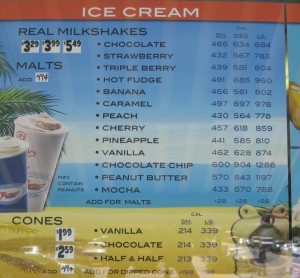
Staring at the menu board on a recent and rare trip to a California fast-food chain, I was stunned by the cost of a milk shake: 880. Eight dollars for a milk shake, really? Well, no. That was the cost in terms of calories. But I would have gladly traded that in dollars and cents to be spared the knowledge of how many calories my post-triathlon race reward would cost me. Feeling sufficiently guilty once confronted with the calorie content, I downsized and saved a couple hundred calories. But I left feeling dissatisfied and unambiguously worse off.
This kind of experience could be coming to a restaurant near you by January, when the FDA plans to roll out mandatory calorie labeling regulations approved by Congress in the same bill that authorized ObamaCare. At chain restaurants with more than 20 locations, you won’t be able to avoid the calorie information, which is prescribed to be posted on menus and menu boards near prices and printed at least as large. So much for the days of blissful ignorance.
While the calorie labeling law is intended to improve health outcomes for individuals, it is effectively a government-mandated guilt trip and a sign that libertarian paternalism—the seemingly benign notion that “choice architects” can “nudge” people to make better decisions for themselves—has gone too far.
Economists have long-recognized the importance of information for ensuring well-functioning markets. Price information supports competition as consumers reward low-cost retailers. In the same way, information on product quality causes firms to up their game—making better products. And information about product attributes helps consumers make better matches between their needs and preferences and the offerings of firms. Incomplete information can be costly, leading to monopolistic prices and even the collapse of entire markets. In short, economists value information as the grease that makes the markets run.
So how can a self-respecting economist object to calorie labeling mandates, like those already imposed on chain restaurants in California and New York? The answer lies in the distinction between mandatory information provision and mandatory information consumption.
A policy of mandatory information provision would require restaurants to measure the calorie content of their menu items and make that information available to customers upon request—perhaps on a separate brochure at retail locations. Consumers could then make better-informed decisions at their discretion, weighing tradeoffs between taste and calories as they deem appropriate. Such an intervention would likely be welfare improving—the benefits to consumers from being armed with calorie information at their own choosing could very well outweigh the cost to restaurants of measuring calories and publishing the information.
The cost-benefit calculus for mandatory information consumption, however, is much less clear. What is clear is that it is likely inferior to mandatory information provision because it imposes extra costs on consumers and restaurant owners with no gain in consumer benefit: those who care about calories have access to the information either way. Regulations that force restaurants to post calories on menu boards like they post prices likely raise the cost of compliance relative to the less-intrusive alternative by requiring that all menus be updated as opposed to supplemented by separate calorie menus.
The real added cost of mandatory information consumption rules, however, is the one imposed on consumers who prefer not to know the calorie content of their meal choices. If calorie costs bombard them every time they look at a menu, these individuals are made unambiguously worse off because the government makes them feel guilty for the choices they make. This is a very real cost imposed on consumers that is completely avoided if regulators merely require restaurants to provide information as opposed to requiring diners to consume it. The Harvard economist Ed Glaeser has characterized the calorie labeling law as a “revenue-less tax.” Indeed, much like a tax on soda or cigarettes, labeling requirements raise the cost of consuming foods, particularly ones that taste good. Cleverly disguised, however, the opposition to a labeling law is likely to be less.
Existing research suggests that the benefits of such a revenue-less tax are minimal. Stanford economists, for instance, show (ungated version here) that New York’s law reduced calorie consumption per transaction at Starbucks by a mere 6% and didn’t change drink consumption at all. Tracking the purchases of anonymous Starbucks cardholders, they found no change in individuals’ common drink orders that could be attributed to the law. Mandatory calorie labeling in NYC, they estimate, reduces long-term body weight by less than 1%.
In the absence of a strong claim that mandatory calorie labeling improves welfare for a majority of Americans, surely the libertarian policy among these alternatives is to make information available to consumers, but to permit them to avoid it if they so choose. After all, the government has very little leeway to make us consume anything. And the notion that government should impose guilt on its citizens must be girded by weaker philosophical principles than those that support libertarian paternalism.
What comes next? When you buy a Cadillac Escalade, will you be confronted not just with the new EPA label telling you how green your car isn’t, but also with an admonition that savings from the cheaper Chevrolet Tahoe would be sufficient to equip 2,300 African children with malaria nets and possibly save their lives? Or will they tell your risk of killing someone in a sedan during a head-on collision is three times higher than if you drove a Toyota Camry?
When you sit down to watch your DirecTV NFL Sunday Ticket, will a government ad warn you that consumption of that product could lead to weight gain, intoxication, diabetes, and heart disease? Or will they admonish you during halftime that if you skipped the rest of the game and went out for a run, you could burn 1,400 calories?
Will the government stick grotesque photos in your face when you buy a package of cigarettes? Oh. Wait . . .
There is nothing libertarian about mandating information consumption. And making people feel guilty just seems paternalistic. The causal-chain from mandatory information consumption to improved health outcomes is so weak that one wonders whether it is worth making people feel bad about themselves—especially when better alternatives exist.

We should stop putting interest rates in big bold type when consumers apply for credit cards and car loans, too. Having them so transparent just discourages consumption.
In fact, why bother displaying prices at all? We should just be handing the cashier our credit card and buying things because “it feels right.”
Well-loved. Like or Dislike:
190
35
You’re comparing apples and oranges, Eric.
When you’re shopping for credit cards and car loans, the interest rate is the price of the money you’re buying. It *IS* the price you’re paying for it.
When you go to a restaurant, the calorie count is one of the features of the meal that may (or may not, depending on your personal priorities) help you decide whether what you’re buying is worth the price you’re paying for it.
Hot debate. What do you think?
72
72
The nutritional effect of a meal IS a cost. EVERY effect of a purchase is a cost (or benefit). What one saves in cheap unhealthy food up front, one will pay for later in medical bills and reduced quality of life. Forcing consumers to find the hidden price information they need to calculate the real costs of goods is simply unfair. Consumers have an individual responsibility to make choices for themselves, but businesses should not have ay leeway to hide or obfuscate important information related to those decisions.
Well-loved. Like or Dislike:
86
23
Currently the cost of obesity is not reflected in the price. Any method to increase the implicit cost of foods/drinks that contribute to obesity should be considered. The decline in utility faced by the minority is not outweighed by the potential benefits.
Well-loved. Like or Dislike:
19
8
Sometimes when trying to decide between two books to purchase (and somewhat indifferent to the outcome), I will allow the number of pages (if listed) determine the outcome, choosing the book with the most pages per dollar as the better bargain.
The rational thing to do when given the choice between milk shakes is to go for the one that gives you the most calories for your buck (provided you are relatively indifferent to flavor). If you want a drink to quench your thirst, get some water—its usually free. But, if you’re looking for nutrition, get the most calories for your money. Now we’ll have the information to make these kind of real value choices.
By the way, I’ll have the Large Chocolate Chip Milk Shake, thank you. At 234.6 calories per $1.00, its a real bargain, and sounds delicious too!
Well-loved. Like or Dislike:
19
6
Blaming Libertarians for nanny state measures? I’ll have what your smoking
Well-loved. Like or Dislike:
131
13
I love slippery slope arguments. So, instead of this being a case where people are being given the ability to make decisions on their own, it’s now a case of the government is telling us what to do. How exactly are you supposed to make informed decisions without information?
Well-loved. Like or Dislike:
137
14
It’s not the government’s responsibility to provide you that information, nor is it the government’s responsibility to force by law the restauranteur to put it on the menu.
It’s YOUR responsibility to gather that information yourself, and you’re perfectly free to not patronize restaurants that don’t provide it to you when you ask, or, if you prefer, to not patronize restaurants that don’t put it on their menu for you to see.
Hot debate. What do you think?
66
76
how long have restaurants been around? and how many are currently willingly displaying this information?
Well-loved. Like or Dislike:
35
9
But it IS the government’s responsibility to ensure for the health of its citizens. I don’t think I need to provide any statistics on the damage caused by obesity in this country. If you want to be obese, thats your prerogative. But your health impacts society (as a member of the workforce, consumer of healthcare whether its paid for by the govt or not), and so long as it impacts society, it is the government’s prerogative to defend those adversely affected (those who are overweight and the taxpayers who pay medicare, medicaid, VA…). When a citizen chooses to take actions that are injurious to society, even on such a small magnitude, they should be aware that they are doing so.
If you are so upset by knowing the caloric value of your food, why don’t you kindly ask another restaurant patron to read you the menu items, omitting the calories.
Well-loved. Like or Dislike:
60
39
And the argument that the effects of the policy are minimal ignore the tremendous societal payoff from even tiny reductions in calorie consumption. This Lancet study, just out today, demonstrates that reducing national body weight by 1% would prevent “2.4 million cases of diabetes. We would see up to 1.7 fewer cases of cardiovascular disease. As a population, we’d add 16 million more ‘quality life years’”.
Well-loved. Like or Dislike:
37
14
It really isn’t the governments responsibility to have anything to do with my health. I’m astounded at the number of people commenting who think that it is the government’s business. Where does it end? Oh, you can’t eat that because you have hypothyroidism and it might make you fat. One day we’ll all wake up and have absolutely no autonomy or privacy. One small step at a time to no freedom.
By the way, I’m pretty sure that everyone knows that a milk shake isn’t a ‘healthy’ choice. Showing the calories won’t change that. It’ll just cost the companies millions of dollars to change their signs with little to no change in the obesity rate.
Another boondoggle created by this government. I’m sure it’ll do alot to boost the economy…
Hot debate. What do you think?
54
57
One day Congress will legislate that we all must eat PEOPLE?!!!!? Oh My God, run for the hills! The slippery slope argument… I wish the government would make it illegal.
1) posting calories will help some people make healthy decisions.
2) restaurants that have 20+ locations probably have the money to change their menus (which they do all the time anyways)
3) it will help sign-makers!
4) putting calories on the menus doesn’t prevent you from ordering what you want. It simply provides information.
Could you provide an argument for why the government has no place in protecting the health of it’s constituents? I’d like to hear it.
Well-loved. Like or Dislike:
46
18
I thought our first “small step” to no freedom was the 2001 Patriot Act. No, you’re right. I’m sure more caloric information will be remembered by our Huxley-an Soma-stoned children and grandchildren as the catalyst of our demise.
Well-loved. Like or Dislike:
18
7
No it isn’t. It’s the government’s responsibility to protect us from aggressors, not ourselves. It’s your responsibility to keep yourself healthy, no one elses. Your ‘it’s not my fault’ thinking is one of the main problems with this country.
Well-loved. Like or Dislike:
58
30
Can I double-like this?
Well-loved. Like or Dislike:
23
17
You can’t keep yourself healthy if third parties are selling you food that is less healthy than you think it is. How is it remotely feasible to for every individual person to fully vet the entire range of goods and services that they purchase on a daily basis? The reason these sorts of consumer protections exist is because no reasonable consumer can afford to protect themselves on their own. Without them consumers will revert to buying pigs in pokes because in order to function in this modern society purchasing decisions must be made quickly.
Well-loved. Like or Dislike:
35
21
Each person should be allowed to do whatever he/she wishes so long as it does not hurt another person. Agreed? Great.
While you may think that your health doesn’t affect others, it does in a number of ways. For example you may not be fit for military service if called on by your country to defend it, or you may require special accommodations on public transit or buildings.
You seem to think the morbidly obese simply sit in their recliner and die from heart disease– thats not what happens. They will go to hospitals when they can’t breathe or their heart stops. This not only uses up valuable resources that could be used to help others but in the case of many americans without health insurance, have their bill entirely covered by the government!
And why aren’t they insured? Well, maybe its because insurance for those with chronic diseases runs a person tens of thousands of dollars per year. And why is it that expensive? Well, in part, its because there are so many obese people in our country with chronic diseases!!!!
And people like you pretend that it’s their right and their fault for being obese. If it is such a choice, then why are obesity rates so correlated with demographics?
Well-loved. Like or Dislike:
43
14
I think this gets to the heart of the matter. So here’s a quick summary of long argument:
For better or worse, overwhelming research demonstrates that the bulk of humans feel compassion for each other. In econ lingo, your welfare affects my utility function. This dynamic creates a big problem for libertarianism, because your choices that harm your welfare create externalities for me. And even many libertarians acknowledge that we need regulation to control externalities.
So we create social safety nets. This policy ameliorates the problem of your suffering – but also compounds the externality problem if you engage in conduct that increases the cost of the social safety net.
Sexton seems to miss the point of the regulations entirely. Government isn’t promoting the dissemination of random information; it’s promoting the dissemination of factual information that is designed to “nudge” you to behave in ways that are socially beneficial. Why did Sexton make a choice that makes him feel “dissatisfied and unambiguously worse off” today? Because at some level he realizes that it’s the right decision in the long run. That is, the market test showed that he preferred that decision, all his subsequent whining notwithstanding. And, lo and behold, his informed decision also coincided with the best interest of society!
He exercised free will. Society got a good outcome. Where’s the beef?
Well-loved. Like or Dislike:
47
10
Support your local FREErider!
Granted that you cannot do just one thing. Every action has consequences. Nonetheless, external costs are what they are. If you live downstream and are affected by these externalities, what gives you the right to use governmental power to force someone else upstream to bear your costs?
When the cry goes up “Unfair!”, look to see who it is who is crying out. What bad decisions did they make, do make, and will continue to make?
When someone gets labeled as a “freerider”, beware of the statist who is speaking, as the President did when he labeled as “freeloaders” people not covered by health insurance to justify his insurance purchase or be fined mandate.
Stop and question what the agenda and motivation is of the person crying “freerider!” Freerider is in the eye of the beholder. And as the “free” should be a hint, its usually not a bad thing.
Hot debate. What do you think?
9
12
The Government isn’t some alien third party, it represents the collective will of a MAJORITY of the population. If most people are sick of having to bare the cost of determining calorie counts or are aware that the lack of such counts encourages them to overeat, then it is the prerogative of the people to enact changes that make their lives easier. Hell, even if you don’t want to debate the merits of majority rule examine it from an efficiency point of view. It is more efficient for consumers to ask for calorie information every time they go out to eat or is it more efficient to just have that information posted? Restaurants rely on this inefficiency to discourage customers from learning the information, which in turns causes them to eat more. That is a market failure and should be remedied via an external body.
Well-loved. Like or Dislike:
30
22
the worst thing about this is that we are being presented a slippery slope argument on FREAKONOMICS, for godsake. is that not antithetical to the whole premise of this site?
the quality of posts are going steadily down.. there is nothing innovative or “freakonomical” about this post. it is purely an opinion piece–and one that is clearly at odds with the levitt-dubner push for MORE info MORE data MORE understanding.
i’m frankly disappointed that the formerly apolitical freakonomics blog is headed into shill territory.
Well-loved. Like or Dislike:
59
4
I completely agree with the libertarian whiners: no calorie counts! We need to perform all our mandatory food energy counting using the appropriate unit: the joule.
Well-loved. Like or Dislike:
69
4
If published calorie counts were such a huge factor, wouldn’t the consumption of beer, frozen pizzas, candy bars, ice cream, cheese, and salad dressing be way down?
Instead, to use the beer example, hoppy craft beers, most of which have more calories than Budweiser, are soaring in popularity.
Well-loved. Like or Dislike:
19
5
when was the last time you saw a calorie count on a beer, other than things like Bud Select 55?
Well-loved. Like or Dislike:
9
2
First, nobody is saying that posting calorie counts is a HUGE factor, but it is a factor.
Second, calorie counts are not posted prominently (if at all) on most bottles of beer.
Third, the calorie content of beer is highly correlated with the alcohol content: those hoppy craft beers may have more calories, but they also have more alcohol so it takes fewer to get buzzed (so the total calories consumed is very close).
Fourth, healthy eating is not foremost on the minds of most beer (or other alcohol) consumers.
Fifth, there actually is a huge market for lower calorie beers, unfortunately they all taste weak and have little alcohol. If you can figure out how to make a hoppy craft beer that only packs 100 calories you would be a very wealthy man.
Well-loved. Like or Dislike:
9
0
“Fourth, healthy eating is not foremost on the minds of most beer (or other alcohol) consumers.”
This goes right to the heart of the mater, and illustrated one of my main issues with mandatory calorie postings: it’s probably not going to help the people it’s intended to help.
There are a lot of obese Americans. Obese Americans are obese (for the most part) because of poor lifestyle choices. I don’t think anyone can claim they thought eating McDonald’s Big Macs daily was a healthy lifestyle option. Any reasonably intelligent person can figure out that fatty foods probably have a lot of calories and, coupled with a sedentary lifestyle, will lead to obesity and the associated health problems. However, obese people continue to make those lifestyle choices. It’s not likely that they will change that lifestyle because of some numbers on the menu board. Also, it’s not likely to help lower-income obese people because, for around $6, and individual can have a pretty large meal and come away feeling satisfied and full while healthier, lower calorie options cost more and provide less immediate satisfaction.
This regulation is more likely to impact on people who are already health conscious- the author himself had just completed a triathlon before having his milkshake- and more prone to make healthy lifestyle choices anyway. Those people are probably more educated on the nutritional value of what they eat on a regular basis- they’re already aware the skim has less calories than whole milk, or that grilled is preferably to fried. They really don’t need the calorie counts because they probably already have a fairly decent idea of whether or not the item represents a good choice or a bad choice, and if they’re not sure, they’re more likely to ask for the supplemental calorie menu.
We can argue about the philosophical merits of paternalism or social engineering (which is what this is) all day. But really, the problem with this regulation is that it’s paternalism that doesn’t serve it’s intended purpose. It doesn’t accomplish its purported goal of reducing obesity especially among already obese people and lower income people, so it’s a waste of time and resources. It’s not just the direct cost of putting the information on the menu, and how that cost WILL be passed on to consumers in terms of dollars and guilt- it’s the opportunity cost to society of the time wasted to do all this, which could have been spent on programs or activities that will actually accomplish the purported goal- to reduce obesity and improve overall public health in the most efficient manner which yields the most results…
Also, I hate this because I don’t want to be confronted with the 460 calories in my once-weekly venti mocha- I did not order it with a shot of guilt and self-loathing.
I _love_ it when they put calorie counts up. Paternalistic? Maybe, but I say maybe not.
See, restaurants have been sneaking additives like HFCS into everything in order to make supplies stretch more. These add a ton of calories and no nutrition. It makes it impossible to compare the calories in the dinner item to what I might have at home.
For example, I order a bowl of spaghetti. Marinara, at home, is 48 calories, pasta is 221. They, however, have added HFCS to the sauce, bumping it up to 250. Because carbs don’t make you feel full the same way proteins do, I don’t sense the difference like I would if they had simply added 150 calories worth of meatballs.
Instead of shaming the consumer, I hope this shames the restaurants out of adding crap to their food just to make it go a bit further.
Well-loved. Like or Dislike:
81
10
Yes! I am not sure how I feel about the restaurants being required to post them so prominently, but I do wish we could require them to publish calorie counts in a way you can access online or in the restaurant. I recently started counting my own calories to lead a healthier lifestyle and I was amazed how many places (chains included) either post no nutritional information at all online, or who only post the calorie counts they are proud of. I no longer frequent those places because I feel I can’t make an informed decision.
Well-loved. Like or Dislike:
9
1
Weak. Making the information accessible is a big part of making it worthwhile. The less available it is (such as having to ask for it on some unseen document), the less useful it is.
If knowing what you’re doing hampers your enjoyment of doing something, then clearly you understand that you shouldn’t be doing it. So don’t.
And the slipper-slope whining at the end of the article would be comical if it weren’t so pathetic. Quite honestly, if people knew that buying a ridiculous Chevy Tahoe came with some many drawbacks, maybe they’d reconsider, and the rest of us wouldn’t have to deal with their inability to navigate a crowded parking lot.
Well-loved. Like or Dislike:
85
13
So where does that end? Maybe the government should just regulate every single aspect of our lives and then we won’t have to make any choices. That would be wonderful. We can all wear black clothes, drive cars that look alike and get the exact same amount of money from some government fund. Tell me, where does this government intrusion end and why are you okay with it? Truly amazing to me.
Hot debate. What do you think?
18
30
you are arguing against something that isn’t at issue here. no one is adding any regulation to your life. the only “intrusion” is that you get more information today than you used to.
Well-loved. Like or Dislike:
20
10
In all of the examples presented, there’s no regulation. The government doesn’t prevent you from buying a Tahoe, even though it’s more expensive, more likely to kill someone else in a crash, and gets worse gas mileage.
Providing information that makes you feel bad about your decisions is not regulating your behavior. It’s an attempt to get you to regulate your won behavior, which is the ideal.
Well-loved. Like or Dislike:
11
2
@Scott – he said “libertarian paternalism,” a specific term referring to measures designed to provide consumers with more info to make good choices (the paternalism part), but still insure that they do indeed have a choice to make (libertarian part). Coined, or at least crystallized, in the Sunstein/Thayler book “Nudge” linked to in the article.
Well-loved. Like or Dislike:
22
8
as opposed to the more accurate and shorter “soft paternalism,” intentionally misleading
Well-loved. Like or Dislike:
17
1
But note that providing the information doesn’t force anyone to make those “good” choices. Those so inclined can use it to make bad choices, too.
Well-loved. Like or Dislike:
8
1
Also, providing information doesn’t make it mandatory that you consume that information. Unless and until they require you to order including the calorie count of your items, how are you being forced to consume that information?
It actually seems the author is the one who wants to be saved from himself — don’t put information right there where I feel compelled to read it!
Well-loved. Like or Dislike:
9
1
Thad, your definition of libertarian paternalism is close but not quite correct. Libertarian paternalism is not only about measures to provide information to consumers, but about any measure to make people more likely to make decisions that the policy maker believes will be in their best interest. The canonical example is how you arrange food in a cafeteria line. Placing the desserts towards the end of the line instead of the beginning does very little to change my information set (and does nothing at all to my information set if I already know what all the items in the line are). But it does systematically lead people to be less likely to take the dessert, without reducing at all the ease of actually taking the dessert if I really want to.
There is quite a large range to libertarian paternalism, from policies that are extremely libertarian (like changing the order in which items are listed) to not-very-libertarian-at-all (like high cigarette taxes, which are “libertarian” only when compared to outright banning).
Sexton seems to be arguing that the mandatory consumption of information crosses beyond the line that he’s willing to call “libertarian.” Setting aside his rather goofy slippery slope arguments, the post does offer one sensible piece of analysis: are the gains from the calorie counts (in terms of better decisions) enough to outweight the costs (in terms of psychological angst)?
That’s a very complicated question, and one he treats far too glibly. He refers to evidence that shows real effects of this measure on calorie consumption, but then simply asserts that these effects are too small to justify the psychological angst. As other commenters have pointed out, though, those effects can add up to large health benefits. Equally importantly, there’s good reason to believe that people don’t yet know how to use this information effectively; as policy makers and consumers become more sophisticated, it’s likely that the benefits-to-cost ratio will improve, as people develop working rules of thumb about calorie consumption and also adapt to the guilt trip part of it. (Adaptation may reduce the health benefits, but only by reducing the costs as well.)
Well-loved. Like or Dislike:
9
2