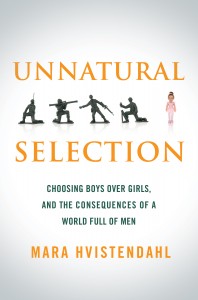
Mara Hvistendahl‘s research features prominently in our latest podcast, “Misadventures in Baby-Making.” Her book, Unnatural Selection: Choosing Boys Over Girls and the Consequences of a World Full of Men, looks at how advancements in prenatal technology have led to extreme cases of gender selection across much of Asia.
As economic development spurs people in developing countries to have fewer children and gives them access to technologies such as ultrasound, parents are making sure that at least one of their children is a boy. As a result, sex-selective abortion has left more than 160 million females “missing” from Asia’s population. It’s estimated that by 2020, 15 percent of men in China and northwest India will have no female counterpart. The consequences of that imbalance are far-reaching and include rises in sex-trafficking, bride-buying and a spike in crime as well.
Mara is currently a Beijing-based correspondent for Science. She has kindly agreed to answer your questions on her book and research. So, as always, fire away in the comments section, and we will post her replies in due course. In the meantime, here is the table of contents of Unnatural Selection.
Part One: “Everyone Has Boys Now”
Chapter One: The Demographer
Chapter Two: The Parent
Chapter Three: The Economist
Chapter Four: The Doctor
Chapter Five: The Imperialist
Part Two: A Great Idea
Chapter Six: The Student
Chapter Seven: The Doomsayer
Chapter Eight: The Geneticist
Chapter Nine: The General
Chapter Ten: The Feminist
Part Three: The Womanless World
Chapter Eleven: The Bride
Chapter Twelve: The Prostitute
Chapter Thirteen: The Bachelor
Chapter Fourteen: The World
Chapter Fifteen: The Baby

From as purely objective standpoint as possible, what would be the effect of eliminating or severely curtailing legalized abortion on these trends?
Also, why do we not see this problem pronounced in Western cultures, even though abortion is legal (to the point of being encouraged) and ultrasounds are commonplace?
The problem is much, much larger than abortion alone.
India just completed a census. When they compared 2011 data with 2001 data they found that in one state, Uttar Pradesh, more than 1.5 million girls have gone missing. The girls existed when the family was polled in 2001 bit did not exist in 2011. That’s just one state.
The Indian government is now going through the process of trying to discover where they all went.
Fact is, they already know the answer. Parents must provide a dowry for a daughter to get married. When that marriage occurs the girl leaves her parents forever. That’s why girls are unwanted. Indian families mourn the birth of a baby girl. They are seen as an expensive burden. Boys, on the other hand, receive the dowry. They remain in the home to take care of their parents. They are a profitable help. Their birth is celebrated.
I spent six month of 2011 in India. Virtually every day there were stories in the newspaper about parents allowing their infant girls to die of exposure or how they were left to even more horrible fates.
Abortion is not the problem. It is one symptom. Remove it as an option and many more female babies will suffer much worse.
While there I continually met well intentioned people who know the full extent of the problem yet downplayed and minimized the reality. A few honest individuals have the courage to speak up and tell the truth. For this they are labeled self-hating Indians and are promptly shut-up one way or another.
Interesting article about wife sharing among brothers in today’s Daily Mail. Could this be the solution?
http://www.dailymail.co.uk/news/article-2054420/Wife-sharing-brothers-haunts-Indian-villages-number-girls-decline.html
A million tiny factors influence mate selection. Pheromones, personality disposition, facial symmetry, and dissimilar immune systems are just a few.
For thousands of generations those from the Indian Sub-continent have practiced arranged marriage, effectively short-circuiting this natural selection. Fathers – and sometimes the mothers – chose the person they believe to be suitable mates for their children.
Is this not the ultimate Unnatural Selection?
How do you measure “missing”? I can think of few ways (# of counterparts to males born, current population percentage…), but how do you compensate for likelihood of early death (or life) in the data? Also, do address the difference between aborted, allowed to be born and then abandoned, died early from malnutrition, not included in official records, etc?
I’m not sure if I come to late to this.
I was wondering if sex-selective abortion/infanticide was also ever a trait observed in any Western countries? If not, is this because they developed earlier, and experienced changes in attitudes towards women and their role in society earlier, and so missed out on the technologies like ultrasound that seems to be making sex-selection so much easier today?
I wrote a response to one aspect of the automatically dire interpretation of these data on my own website, The Naked Anthropologist.
at http://www.lauraagustin.com/if-this-were-about-men-they-would-be-seen-as-empowered-sex-selection-sex-trafficking-and-girls#comments
Laura Agustin