
Why Does a Caucasian Dollhouse Cost Nearly 70% More Than an African-American Dollhouse?

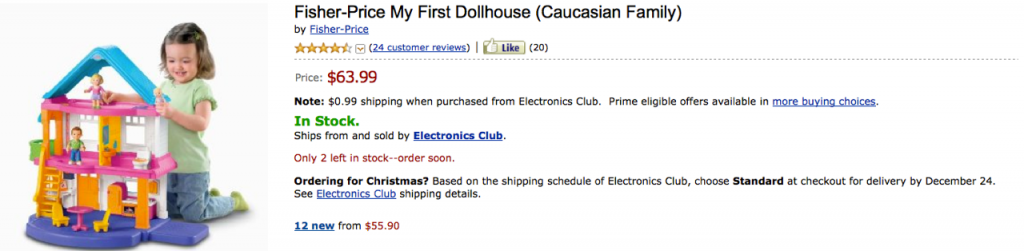
If you were shopping on Amazon.com last night for a Fisher-Price “My First Dollhouse” with a Caucasian family, you would have been asked to pay $63.99:
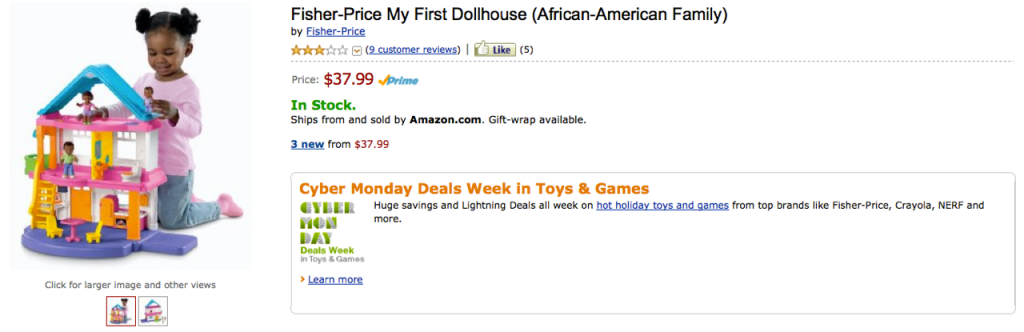
If, however, you wanted to buy what looks to be a nearly identical “My First Dollhouse” with an African-American family, the price was only $37.99:
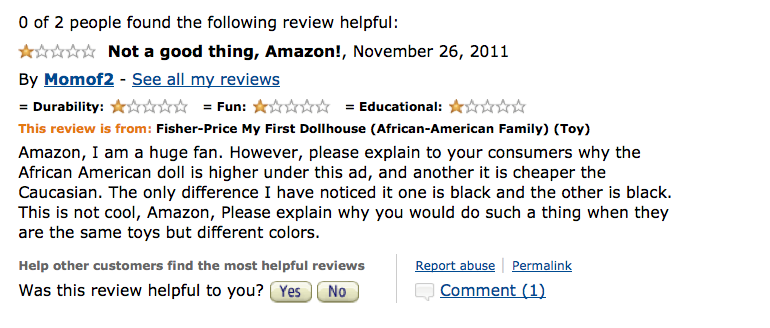
Amazon reviewers have taken note, and aren’t pleased:
When my son Solomon (11 years old) wandered past my computer last night as I was looking this over, he didn’t need any prompting: “That’s so racist!” he said.

Is it? What is it that we’re seeing here on Amazon — racial discrimination? Price discrimination? Neither?

When I went back to the site this morning, I saw that the Caucasian dollhouse price had fallen to $55.87:
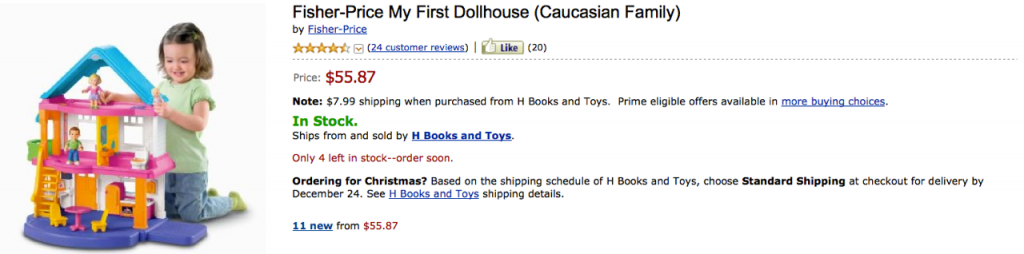
But the shipping fee was now $7.99, for a total of $63.86. The shipping fee for the $63.99 offer was only $0.99, for a total of $64.98. So the actual price had fallen only $1.12.

But the price change reveals something more telling. The two prices were offered by two different third-party vendors: H Books and Toys and Electronics Club.

The African-American dollhouse, meanwhile, is sold directly by Amazon.

I would assume that Amazon had no intention of charging such a steep premium for the Caucasian dollhouse but by creating a third-party marketplace, has opened itself up to this kind of discrepancy.

I have a few thoughts:

1. Amazon may not even be aware of this discrepancy.

2. Perhaps Amazon had bought from Fisher-Price a certain number of Caucasian dollhouses and offered them at the same price as the African-American dollhouses but the supply ran out, with the order now deferring to a more expensive third party.

3. If Amazon isn’t aware and becomes so — or if an outcry were to arise — it may well step in to strike down the unequal pricing. I would also imagine Fisher-Price would have something to say.

4. There is evidence that white and black children both prefer white dolls. So, the controversial element notwithstanding, are we simply seeing a demand-and-price story here? 

5. I can easily see this scenario prompting a lawsuit, from someone, if only for show.

(HT: Younes Chajia)

Leave A Comment

Comments are moderated and generally will be posted if they are on-topic and not abusive.


COMMENTS: 69

  1. jay075j says:

    Where is Al Sharpton on this one? I want to see what the NAACP has to say!!!

    Thumb up 0 Thumb down 3

  2. aepxc says:

    So is the racism in the fact that Amazon chooses not to carry/makes more expensive the caucasian dollhouse (thereby hurting its potential buyers), or that it positions african-american dolls as being ‘cheaper’/less valuable than caucasian dolls? Or a mix of the two/grossly unequal treatment whatever the implications?

    Thumb up 0 Thumb down 0

  3. Denny says:

    Two products sold by two different companies happen to be differently priced … the horror! Okay, they are advertised on the same site, but it’s really only humans will be making the connection between the different “race” playhouses. Amazon’s complex algorithms, which control of the pricing of products they sell themselves, certainly won’t have the made the connection we are making.

    It’s unlikely any human at Amazon has looked at the price of this product, let alone noticed the product which is coming from another seller (and therefore probably the “responsibility” of another department at Amazon). They’re just selling the “black” dollhouse at what their computer judges right. Steve lists the good reasons why the 3rd party seller will be more expensive.

    If these products were sold at a mall in two different stores (one large retailer known for being cheap, another more specialized/expensive store) at differing prices, would people really be bothered? That’s really all this is.

    Thumb up 1 Thumb down 0

  4. caleb b says:

    According to the Census, whites make up 72.4% (224.5 million) of the population, while black people are 12.6% (38.9 million).

    Econ 101: increased population equals increased demand. There are simply more people that want the white doll house because there are more white people.

    http://quickfacts.census.gov/qfd/states/00000.html

    Thumb up 3 Thumb down 2

  5. Warren says:

    This is nothing more than Dubner stirring up controversy where there is none in an attempt to generate web traffic and comments. This is in a similar vein to what he did yesterday by posting “Smart Stuff From the Comments” to stir the pot again by rehashing Steve Sexton’s post “The Inefficiency of Local Food.” A comparatively big payoff for very little effort on Dubner’s part.

    Hot debate. What do you think? Thumb up 3 Thumb down 9

  6. VenusMoon says:

    Thanks for the article. I believe you’re asking all the right questions given Amazon’s business model. While I shouldn’t have to say this, I will because of the nature of the story. I am African-American. My question is for the Freakonomics Team: was the amazon review you posted in this article truly the most articulate of the bunch? It hardly seems worthy of mention here given your academic credentials. Yes, I understand what the person is trying to point out but it’s poorly written and reads like gibberish. I would have expected you to select a more articulate reviewer to use as an example. Still, love your work and appreciate you bringing us interesting material everyday.

    Thumb up 5 Thumb down 2

  7. stoptheinsanity says:

    I shop all the time at Amazon. I even have a pattern of shopping in stores then coming back to my browser where I have a ‘hot button’ to Amazon and buying from them once I know exactly what I want.

    The pricing discrepancy is NOT an Amazon issue nor is it an intended race issue. It is simply a matter of what supplier has the product available at the lowest price.

    As an economist – when you say – “If Amazon isn’t aware and becomes so…it may well step in to strike down the unequal pricing. I would also imagine Fisher-Price would have something to say.” – it tells me that you are suggesting that they create a ‘fair and balanced pricing structure’ – artificially. Why would yo do that?

    If the pictures with the a Caucasian girl and an African-American girl were provided by Fisher-Price, isn’t it equally their responsibility? Further, is it not possible that the comapny that is selling the dollhouse with an minorities image is also minority owned and feel that maybe they should advertise to the minority? If that holds tru is that then culturla bias or racism?

    Further, how many children of the targeted age actually surf Amazon.com looking for doll houses? Your comment that both white and black children equally prefer white dolls holds no import here. The parents are doing the shopping, the parents are doing the buying – and the parents are voting when they select which version to buy or not buy.

    I typically like Freakonomics when I see the facts, but when you start stepping into the conjecture line without talking to all parties involved? Now I am beginning to think you have an agenda and it isn’t one that means well.

    Thumb up 1 Thumb down 1

  8. Briana says:

    Um….one is priced directly from Amazon.com as the seller. The other is priced from a third party. That explains the difference to me. Things priced from Amazon.com are often CHEAPER than the 3rd party retailers. No racism…just different sellers on Amazon.

    Thumb up 1 Thumb down 0