
Bring Your Questions for Skeptic-in-Chief Michael Shermer
(Courtesy of Skeptic.com)

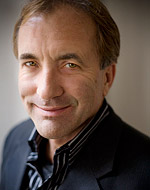
Michael Shermer is perhaps the world’s only professional skeptic. As the founding publisher of Skeptic magazine and executive director of the Skeptics Society, Shermer has turned his innate skepticism into a full-time job. In our recent podcast “The Truth Is Out There…Isn’t It?” Stephen Dubner talks to Shermer about the evolutionary basis for our tendency toward “magical thinking” and why humans are conditioned to see threats often where none exist. Here’s an excerpt:

SHERMER: Our brains are designed by evolution to constantly be forming connections, patterns, learning things about the environment. And all animals do it. You think A is connected to B and sometimes it is, sometimes it isn’t, but we just assume it is. So my thought experiment is, imagine you’re a hominid on the plains of Africa, three and a half million years ago. Your name is Lucy. And you hear a rustle in the grass. Is it a dangerous predator, or is it just the wind? Well, if you think that the rustle in the grass is a dangerous predator and it turns out it’s just the wind, you’ve made a Type 1 error in cognition – a false positive. You thought A was connected to B, but it wasn’t. But no big deal. That’s a low-cost error to make. You just become a little more cautious and vigilant, but that’s it. On the other hand, if you think the rustle in the grass is just the wind, and it turns out it’s a dangerous predator, you’re lunch. Congratulations, you’ve just been given a Darwin award for taking yourself out of the gene pool before reproducing. So we are the descendants of those who were most likely to find patterns that are real. We tend to just believe all rustles in the grass are dangerous predators, just in case they are. And so, that’s the basis of superstition and magical thinking.
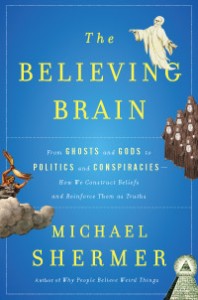
Shermer’s latest book (his twelfth) is called The Believing Brain. Considered his magnum opus, the book synthesizes Shermer’s three decades of research to present a comprehensive theory on how beliefs are born, formed, nourished, reinforced, challenged, changed and finally extinguished. Shermer ranges across politics, science, sports and economics  to look at how the brain manufactures beliefs first, then goes about building up explanations for them.

Shermer has agreed to answer your questions. So, as always, fire away in the comments section, and we’ll post his responses in due course (here). To get you started, here’s the table of contents from The Believing Brain:

Prologue: I Want to Believe

Part I: Journeys of Belief
1. Mr. D’Arpino’s Dilemma
2. Dr. Collins’s Conversion
3. A Skeptic’s Journey

Part II: The Biology of Belief
4. Patterncity
5. Agenticity
6. The Believing Neuron

Part III: Belief in Things Unseen
7. Belief in the Afterlife
8. Belief in God
9. Belief in Aliens
10. Belief in Conspiracies

Part IV: Belief in Things Seen
11. Politics of Belief
12. Confirmations of Belief
13. Cosmologies of Belief

Epilogue: The Truth is Out There

Leave A Comment

Comments are moderated and generally will be posted if they are on-topic and not abusive.


COMMENTS: 49

  1. Dan says:

    Without saying what is true or not, objective evidence suggests atheism as a dominant ideological basis for a society is fairly detrimental to that society, even though its advocates argue that it is enlightened.

    (1) Nations that have adopted atheism in their foundational principles, i.e. Marxist nations, have been the most murderous with the least value placed on human life of any nations in history. It is not even close. They are responsible for an estimated 100 million murders among them (17 holocausts’ worth). No religious group in history has come within miles of that record.

    (2) Even when not actively murdering people these places (e.g. present-day Russia, China, Eastern Europe) are almost bankrupt of social capital. Witness the shocking hardheartedness of Chinese passers-by when children run over by cars lie dying in the street. These places have done a far poor job than most others of upholding the very ideals the Skeptics presumably value.

    (3) Finally, there is the demographic conundrum. Nations with little belief mostly are going into demographic collapse with about 4 dozen modern examples that I can think of and Russia leading the charge. Exact reasons are hard to come by, but clearly individuals in those nations are not finding long-term meaning that extends beyond their own lives. Michael Shermer certainly exemplifies the trend.

    Meanwhile those nations with vibrant religious worldviews are overwhelming the most fertile, even as they are are seen to be he most backward. I am a patent examiner and Israel is the only nation in the world that presently combines a significant rate of patent application filing with above-replacement fertility. There were once many such nations. Our most fertile nations have astoundingly little patent output, while most nations of the West are going down a path of demographic collapse. Population replacement is occurring at a rapid clip and the upshot of vibrant secularism in the west may well be a new dark ages. Clearly all manner of ideals go out the window then.

    This is very depressing for those who think an atheist worldview is the truest description of the world we live in. I can reasonably imagine that an atheist of the future would see the need to protect the belief systems in his society, considering them necessary if not very agreeable.

    Those who justify proselytizing atheism on the basis of truth being the highest ideal in a society ought to recognize that any ideal can be taken too far to great detriment to everyone. Hint: Most people who have some belief in the West are trying very hard to build a purposeful life in the face of of a lifetime of skeptical assaults on what they hold dear.

    Thumb up 0 Thumb down 8

    • James says:

      1a) For all practical purposes, Marxism IS a religion.
      1b) Suggest you look at the number of deaths caused by Islamic imperialism. It’s close as an absolute number, and as a fraction of world population at the time is way ahead. Pay particular attention to the autobiography of Timur.

      2) Witness similar events taking place here in the US. Start by looking up Kitty Genovese, then go into KKK lynchings, etc.

      3) “Demographic collapse” is the religionist buzzword for those few localities that have managed, somehow, to start dealing with the serious overpopulation problem that afflicts the rest of the planet. The Earth simply can’t sustain above replacement fertility levels. That you and so many other religionists refuse to admit this is yet another example of religious blindness.

      Thumb up 2 Thumb down 0

  2. Bu$y B says:

    Hey, I’ve got an idea: instead of posing questions for Shermer to answer, let’s all just debate religion, the Big Bang, and natural selection amongst ourselves; Shermer probably never gets questions about those things.
    My question for Shermer: while there seems to be a “scientific consensus” re climate change, many environmentalists don’t trust “scientific consensus” on matters such as genetically modified foods, nuclear power, or evolutionary psychology. How do explain this selective skepticism, which the right engages in even more blatantly? Confirmation bias? And where do you stand on AGW? I’ll be the first to admit the topic is too complex for my little brain, yet most folks seem to know – not think, but know – the truth on this issue.

    Well-loved. Like or Dislike: Thumb up 7 Thumb down 0

    • Mike says:

      I like this question too. It seems to me that people only believe in the science that confirms their world view. Once you present any evidence that contradicts that world view, the science behind it becomes suspect. Another example would be autism caused by vaccines.

      Thumb up 0 Thumb down 0

  3. Nosybear says:

    I think I know the answer but my question is, why, if skepticisim is such a valuable skill in learning, do we not specifically and explicitly teach it in our schools?

    Thumb up 5 Thumb down 2

  4. Eric M. Jones. says:

    There are statements from well-informed scientists regarding:

    1: An infinite number of monkeys at an infinite number of typewriters (whatever they are) writing all the works of Shakespeare.

    2: Multiverses allowing exact copies of earth, you, me and everything else.

    I suspect this is a naive understanding of infinity-math, since any matching pair of identical items has an infinite number of non-matching possibilities. Or alternatively, statements 1 and 2 represent points on a line or a plane, while reality represents points in a solid or higher dimensional shape.

    Eh?

    Thumb up 0 Thumb down 1

  5. frankenduf says:

    do you think that skepticism leads to happiness moreso than faith?- if not, then what is the moral justification for encouraging skepticism?

    Thumb up 1 Thumb down 0

  6. Caleb b says:

    Here’s my question: what is it about the idea of a soul that even people who confess to not have one are hesitant to sell it?

    I have been trying, for the better part of ten years, to buy a soul. I’ve offered a dollar amount, between $10 and $50, for someone to sign a sheet of paper that says that I own their soul. Despite multiple debates with confessed athiests, no one has signed the contract. I have been able to buy several people’s Sense of Humor and one guy’s Dignity, but no souls.

    Additionally, will any Freakonomics reader take me up on this? I’m willing to spend $50 on souls.

    Thumb up 1 Thumb down 2

    • Keith says:

      Caleb b: You can buy my “soul”, “Soul”, “Spirit”, “Eternal Essence”, etc. anytime. Send me the paper to sign, I’ll send you my paypal account.

      Thumb up 0 Thumb down 0

    • Vic Napier says:

      You can have my soul! However, because of its above average quality and unmatched purity I’m asking $100 and a written testimonial attesting to its superior value due within ten days of acceptance. Because my soul is both intangible and transferable, I reserve both the right of subsequent sales to other parties and the use of your testimonial in marketing projects. Please send the paperwork as soon as possible.

      Thumb up 0 Thumb down 0

    • James Arnall says:

      Hi Caleb,

      Interesting, I’ve been trying to peddle my soul for a long time. Send me the paperwork, and if it’s in order (if I’m really just selling you my soul, and not, say, my kidneys too) then the soul is yours.

      Thumb up 0 Thumb down 0

    • Kit says:

      I have a friend who possesses five souls in bottles with five signed pieces of paper from the people who sold them to her. I think she paid $5 each for them but this was a number of years ago so many inflation has caused the price to increase.

      Thumb up 0 Thumb down 0

    • Ken D. says:

      I accept! Please go to http://www.beyondken.com to make your $50 payment via Paypal. Please instruct as to the delivery method.

      I stopped counting after 15 people accepted your offer. As I don’t believe you are telling the truth, I will be very surprised if you keep your word.

      Thumb up 1 Thumb down 0

    • smalljude says:

      Caleb b, this poses a bit of a conundrum for me. I’m perfectly happy to sell you my soul.. but how do I sell you something I don’t have? It feels as if I’m swindling you, and I don’t really like to cheat. Perhaps we can change the deal a little. I also don’t have a cute talking squirrel or a flying carpet, and both of those seem much more interesting to me than a soul. I am willing to give (yes give!) you my soul, my cute talking squirrel *and* my flying carpet in exchange for items of similar worth that you don’t have (I leave the details up to you). I live in New Zealand so I hope that is not a barrier for our transaction.

      Thumb up 0 Thumb down 0

  7. Guestspeaker says:

    Dr. Shermer,

    Why is it that many people see a willingness to change beliefs based on new evidence as “weak”?

    For example, if we say, “I can change my beliefs based on new and compelling evidence”, some (i.e. mostly right-wing, religious zealots) see that as “weak”, “wishy-washy”, lacking conviction, etc. I see it as incredibly humble and mature.

    Thumb up 1 Thumb down 0

  8. Jared Doom says:

    Caleb B. I will absolutely sell you my soul. To be fair, this won’t preclude me from selling it again to other suckers who (a) believe in souls and (b) believe they can be readily transferred on purchase. To be clear I’m offering because I don’t believe (a).

    Thumb up 0 Thumb down 0