
The Economist features an interesting chart this week, showing the correlation between a country’s wealth, and the average amount its citizens spend on Christmas gifts. Note the two outliers, the Netherlands and Luxembourg.
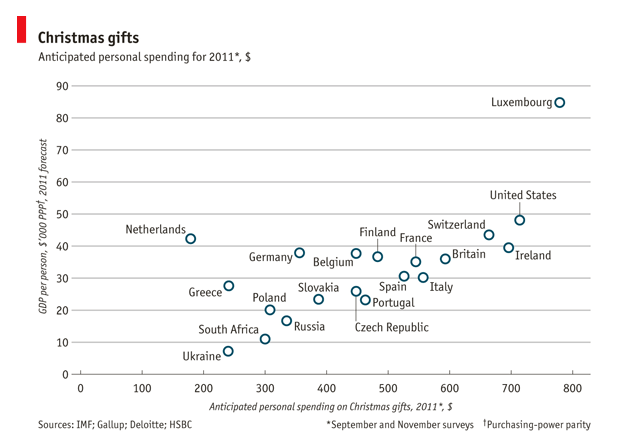
Despite their considerable wealth, the Dutch have clearly maintained their minimalist austerity chic. Not the case in Luxembourg, which has the highest GDP per capita in the EU, and the third highest in the world. So, while you may get a pair of wooden shoes for the holidays from that Dutch relative of yours, that Luxembourgian uncle stands to be much more generous.
It’s also worth noting America’s position. Despite considerably less per capita wealth, we appear to be spending only about $70 less per person than the Luxembourgers. Interesting also that despite their crushing debt woes, the Irish are big givers, at least compared to their PIGS companions: Portugal, Greece and Spain.

Luxembourg is always destined to be an outlier, it’s essentially a banker city. Whereas the rest of the countries have within them plenty of variation, Lux. is relatively uniform.
And while I’m ranting, I feel the axes should be switched. /rant
All families with kids in The Netherlands give presents on Sinterklaas (Dec 5), not Christmas!
I am disappointed that this “research” doesn’t take this into account. It is not a secret or anything.
Oh and we don’t wear wooden shoes. In fact you can only find these in tourist shops!
Believe me, there often is little “dutch minimalist austerity” involved in the dutch Sinterklaas festivities, which (as a previous reader pointed out) falls just before Christmas, and is the main gift giving celebration.
My initial comment, the first one posted, noted that the Dutch Sinterklaas explanation had been mentioned as the very first post on the ECONOMIST web site, where this article came from.
I should have been clearer. I meant to be critical of Levitt or Dubner. They should not have put up this article without also including some of the info from the posts on the ECONOMIST site, which provided such explanations.
A small note, orginaly in the Netherlands no gifts were given at christmas, this was done at sinterklaas. The last 20-25 years there is a shift towards christmas, however families with small children always will have their presents as sinterklaas. This will put the numbers above in a different perspective because the dutch spent their money in 2 shifts in december (5 sinterklaas and 25 christmas december)
The reason the Netherlands spends so little on Christmas gifts, is because the children get their presents at 5 or 6 December, at Saint Nicolas celebration. Christmas is about family and friend dinners.
The reason the Dutch…SanterKlauss..what? That’s already been commented on 18 times?
A possible reason for Netherlands being a outlier could be another holiday in December.
St. Nicolaus day on Dec 5th is celebrated also with significant gift-giving (while remaining Europe only gives small things e.g. chocolate). Since there is only a gap of some weeks between St. Nicolaus day and Xmas day, people may generally give less to those who have already received a “big” gift for St Nicolaus.
The question is if St Nicolaus spending is included in the anticipated Christmas spending data.